Maiden Drilling Confirms Large Magmatic-Hydrothermal System and Gold-Bearing Structures at Kasie Ridge
Great Pacific’s Kasie Ridge maiden assays reveal a large system with wide mineralised zones but no economic gold grades.
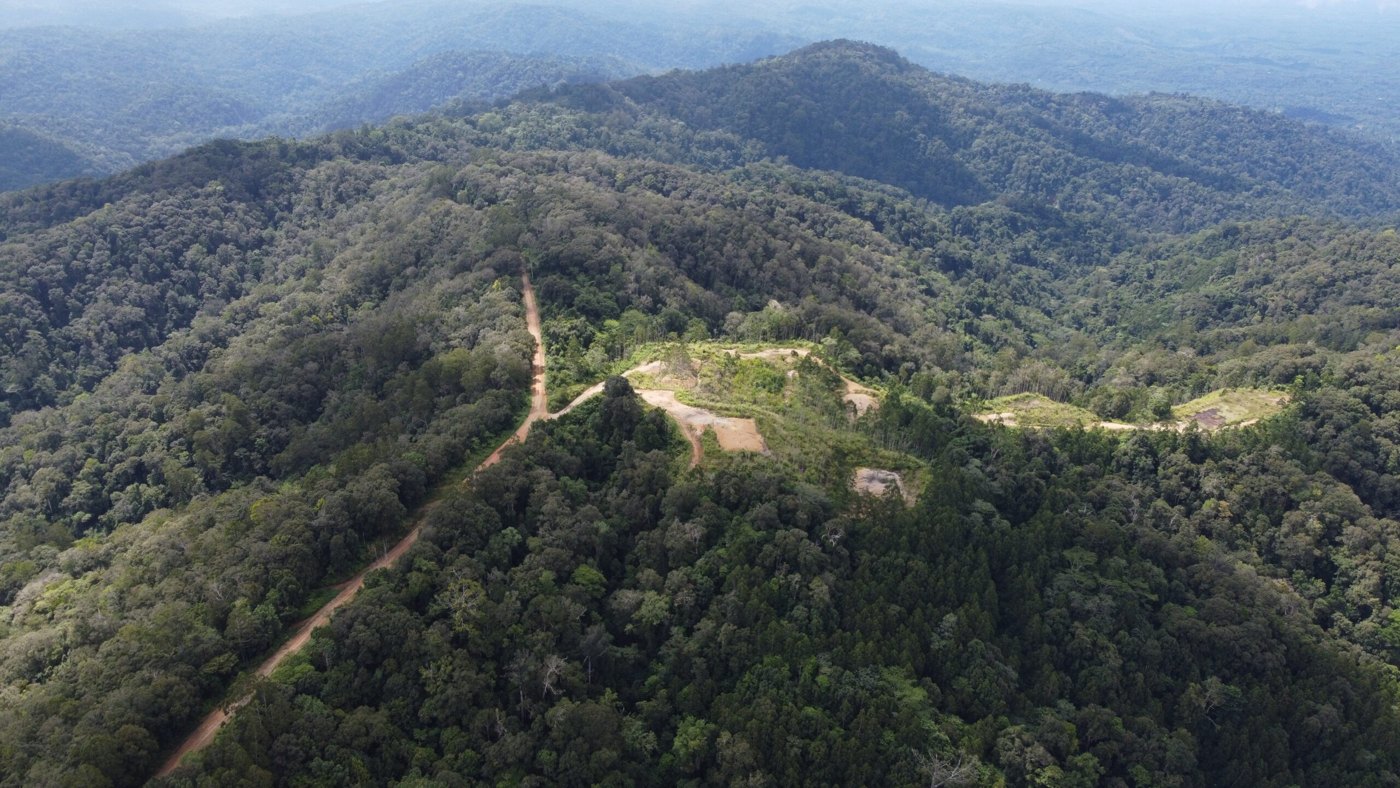
Great Pacific Gold Corp. (GPAC) has completed a maiden two-hole drilling program at the Kasie Ridge target within its Wild Dog Project in Papua New Guinea. The campaign included holes KAS-01A (595.7 m) and KAS-02 (346.6 m), yielding a total of 942.3 m of core. The collars were positioned approximately 315 m apart, with KAS-01 initially abandoned at 174.2 m before being re-drilled as KAS-01A.
The release does not report any composited intercepts, meaning there are no "X m @ Y g/t" intervals. Instead, all gold results are presented as individual point samples. In KAS-02, zone 141-166 m, five samples returned 0.25 g/t at 149.0 m, 1.55 g/t at 151.7 m, 0.38 g/t at 159.6 m, 0.22 g/t at 160.1 m, and 0.20 g/t at 165.6 m. In zone 231-256 m of the same hole, three samples returned 0.47 g/t at 231.6 m, 0.31 g/t at 251.6 m, and 1.25 g/t at 254.2 m.
KAS-01A recorded a maximum gold grade of 0.11 g/t at 572.3 m. A broad silver halo was identified between 263-402 m, peaking at 22.4 g/t Ag at 323.8 m. Copper levels were uniformly low, with a maximum of 0.09%.
Alteration and mineralogy analysis included 105 quantitative XRD results, revealing a zoned alunite-pyrophyllite-zunyite-diaspore suite. Topaz and andalusite were found in the deepest approximately 190 m of KAS-01A. Hypogene anhydrite and visible chalcopyrite were noted below approximately 480 m, while native sulphur was identified at 202.7 m in KAS-02.
Geochemical vectors showed selenium, tellurium, and bismuth rising from less than 1 ppm to 5-20 ppm below 300 m, with a peak of 54 ppm near 445 m. Molybdenum peaked at 53.6 ppm at 421.0 m, and rhenium peaked at 2.84 ppm at 572.3 m. Arsenic and antimony remained low.
Pending results include multi-element data for KAS-02 and 39 XRD results for the 154-337 m interval. The company also has assays pending for 1,639.4 m across nine holes, comprising three holes at Magiabe (590.2 m) and six at Mengmut (1,049.2 m).
Great Pacific Gold described the results as confirming a "large system" with "gold in both holes" and a vector that "strengthens toward the bottom of both holes." The company noted the explicit caveat that the interpreted magmatic source remains untested.
Great Pacific Gold Corp. (GPAC) has drill-confirmed the existence and scale of a large magmatic-hydrothermal system at Kasie Ridge. However, the company reported no change to its resource, tonnage, grade, metallurgy, or economic zones. Kasie Ridge has not transitioned from a "concept" to a mineralized body.
The market had previously anticipated a high-sulfidation discovery based on August 5 and February 24 releases that described "near-continuous silicification," native sulphur, "massive replacement," and a 1.5-2 km advanced-argillic footprint. These visuals carried a genuine, albeit high-risk, expectation of a potential discovery. The new assays disconfirm any economic grade in this first test, representing a downgrade of visual hype and a negative development for the project.
The Kasie Ridge "anchor" was a visual and geological expectation rather than a prior assay. The equity has not re-rated on this expectation, with the stock trading at C$0.21, essentially its 52-week low. This is down from C$0.33 on August 5 and C$0.66 a year ago. Because the market never paid for a Kasie Ridge discovery, the incremental equity damage is considered bounded.
GPAC is a pre-resource explorer with no reserves and no revenue, wholly dependent on news flow and capital raises. While a first-pass null result at one target is ordinary for a company at this stage, the failure to convert a hyped lithocap into any reportable grade is a negative for the "five district-scale porphyry targets" narrative.
According to the Q1-2026 filing and April 2026 presentation, GPAC held C$7.08M in cash at 31 March 2026, plus C$20.02M gross from the April offering. Working capital was C$5.52M at 31 March 2026, with an operating cash outflow of C$3.29M in Q1-2026. The company has no debt. Its estimated enterprise value of roughly C$15M against approximately C$26M of cash remains one of the few genuine cushions in the story and is not altered by this release.
Great Pacific Gold Corp. (TSXV: GPAC; OTCQX: GPGCF; FSE: 0B3) is a pre-revenue, pre-resource gold-copper explorer headquartered in Vancouver, focused on Papua New Guinea.
The company’s flagship Wild Dog Project is located in the East New Britain Province and encompasses a 15 km structural corridor. This corridor hosts the Sinivit high-grade epithermal shoots, the Kavasuki vein system, the EK target area (Elamaraka, Kargalio), the Magiabe/Magiabe West veins, Mengmut, Morgan, and the Kasie Ridge lithocap target. Reported high-grade results include WDG-08 at 8.4 m @ 50.12 g/t AuEq from 154 m, WDG-14 at 9.5 m @ 13.8 g/t AuEq, and Kavasuki KVH-01 at 58.9 m @ 2.50 g/t AuEq and KVH-03 at 38.4 m @ 2.23 g/t AuEq. Two diamond rigs are currently active at the site.
The Kesar Project is situated in the Eastern Highlands, contiguous with K92 Mining's Kainantu tenements. Phase 1 drilling, consisting of 13 holes totaling 3,714.3 m, returned best results of 3.13 m @ 3.67 g/t Au (Anteruno) and 0.94 m @ 3.17 g/t Au (Hampore). Phase 2 drilling of approximately 3,000 m is planned for 2026, contingent on the renewal of EL 2711. GPAC holds 90% of Yaendal Minerals.
The Arau Project is also located in the Eastern Highlands, south of K92. Mount Victor Phase 1 RC drilling was completed in August 2024, and the Elandora licence holds epithermal and Cu-Au porphyry targets.
The Tinga Valley Project is located in western PNG. Former Australian assets, including the Walhalla project, were spun out into Walhalla Gold Corp. in December 2025; GPAC retains a 2% NSR royalty on Walhalla.
Regarding its financial position, prior-period context from the Q1-2026 filing indicates cash of C$7.08M at 31 March 2026, with total assets of C$29.2M and total liabilities of C$2.9M. The company had no debt and a book value per share of C$0.17, with 153,098,465 shares outstanding at 31 March 2026, prior to an April offering. The net loss for the quarter was C$4.77M, with an operating cash outflow of C$3.29M. Subsequent to the quarter end, a C$20.02M gross public offering closed on 2 April 2026 at C$0.47/unit with half-warrants at C$0.70. The April 2026 presentation cites C$26.3M in cash, 265,305,146 fully diluted shares, and an ownership split of approximately 1.7% insiders, 4.9% strategic, 34.2% institutional, and 59.2% retail.
No mineral resources or reserves are disclosed on any project, and the company generates no revenue. Great Pacific Gold Corp. funds exploration entirely from equity issuance.