OUTCROP SILVER EXTENDS SANTA ANA VEIN SYSTEM NORTHWARD AND IDENTIFIES PARALLEL CASCADA VEIN
Outcrop’s Alaska zone ties to Santa Ana over three kilometres while Cascada returned 1,084 g/t AgEq in a 0.74 metre width.
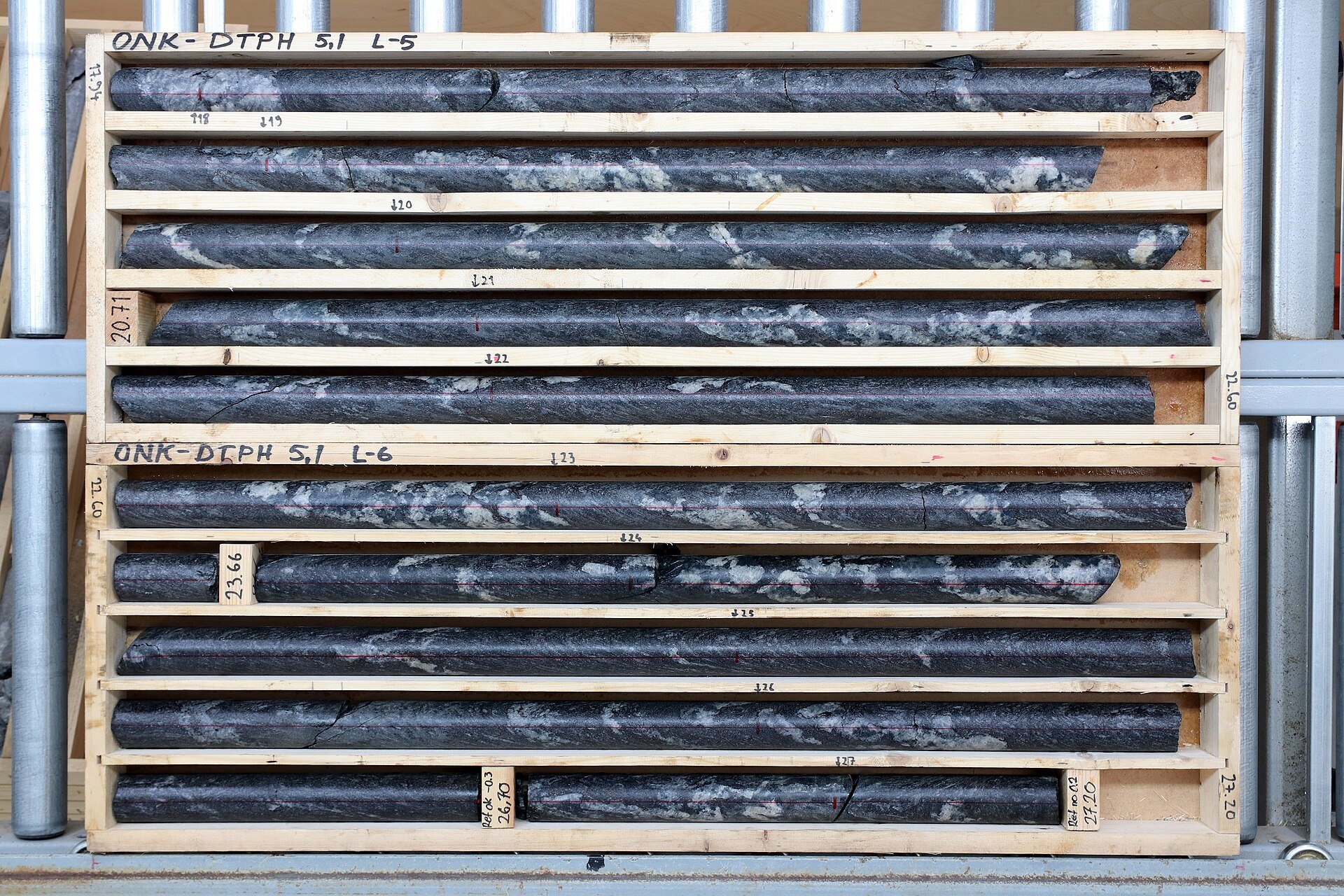
Outcrop Silver & Gold Corporation (OCG) released assay results from 16 holes (DH658–DH687) that test the northward extension of the Santa Ana vein, its connection to the previously independent Alaska vein, and a newly delineated footwall structure known as the Cascada vein.
The Cascada vein yielded significant intercepts in hole DH687, which returned 1.37 m (0.74 m ETW) @ 1,084 g/t AgEq, including 0.30 m (0.16 m ETW) @ 4,725 g/t AgEq. Hole DH658 returned 2.10 m (0.84 m ETW) @ 233 g/t AgEq.
Intercepts from the Alaska vein included DH685, which returned 8.39 m (3.61 m ETW) @ 241 g/t AgEq, including 0.32 m (0.14 m ETW) @ 4,735 g/t AgEq and 0.45 m @ 564 g/t AgEq. Hole DH665 returned 3.43 m (1.26 m ETW) @ 307 g/t AgEq, including 0.95 m (0.35 m ETW) @ 646 g/t AgEq. Hole DH672 returned 2.25 m (0.80 m ETW) @ 197 g/t AgEq, including 0.45 m @ 853 g/t AgEq. Hole DH687 returned 3.23 m (1.52 m ETW) @ 187 g/t AgEq.
Results from the Santa Ana vein included DH670, which returned 1.90 m (1.02 m ETW) @ 270 g/t AgEq, including 0.30 m (0.16 m ETW) @ 1,017 g/t AgEq, located approximately 300 m north of Shoot 7. Hole DH666 returned 2.88 m (1.56 m ETW) @ 134 g/t AgEq.
The Santa Ana and Alaska veins are now interpreted as one continuous structure with an aggregate strike length approaching 3 km. The Alaska vein was not included in the September 2026 Mineral Resource Estimate (MRE) and is being advanced as a candidate for a future update.
A 35,000 m drilling program is currently ongoing with four rigs active and multiple assays pending. The AgEq calculation uses US$3,100/oz Au and US$40/oz Ag with 98.5% Au and 96.3% Ag recoveries.
Outcrop Silver & Gold Corporation (OCG) is an explorer and early-development company with a C$138 million basic market cap and no Mineral Reserves. The company is pre-revenue and funded by equity, holding $22.6 million in cash as of February 2026, alongside approximately C$13 million in cash and C$6 million in securities according to its latest deck. For OCG, drill news is the primary driver of value, making results like these more significant than they would be for a producing mine.
The latest results improve the geological understanding of the district. The Alaska deposit folds into the Santa Ana structure, which is approximately 3 km long, while the Cascada discovery adds a new parallel footwall vein. Alaska was excluded from the September 2026 Mineral Resource Estimate (MRE), so these results point to a future resource-additive target, providing genuinely new information about the scale of the project.
However, the grade substance remains mid-band for the deposit type and is comparable to or weaker than the company's own recent results. Recent intercepts include Las Maras DH637 with 2.86 m @ 2,214 g/t AgEq; Guadual DH567 with 0.84 m @ 2,844 g/t AgEq; Morena DH613 with 0.71 m @ 2,559 g/t AgEq; and Shoot 7 DH648 with 9.16 m @ 188 g/t AgEq. None of the intervals in this release re-rate the deposit grade.
The stock is not currently priced for repetition. It has round-tripped from approximately C$0.62 in January 2026 to C$0.28, near its 52-week low, and has drifted down since the last drill release on September 3 at $0.39 and the MRE on September 14 at $0.33. Because this lower anchor is not embedded, an in-line or modestly positive result can be genuinely additive rather than a miss.
Outcrop Silver & Gold Corporation (OCG) owns the Santa Ana primary silver-gold project, a 100% held asset spanning approximately 28,000 hectares in Falan, Tolima, Colombia. Located within the Mariquita District, the property features a 17-kilometer fully titled mineralized corridor and a silver mining heritage dating back to 1585.
On September 14, the company announced a Mineral Resource Estimate (MRE) effective September 10. The estimate includes an Indicated resource of 1,793 kilotonnes at 519 grams per tonne silver-equivalent (AgEq), containing 29.9 million ounces of AgEq, and an Inferred resource of 2,352 kilotonnes at 368 grams per tonne AgEq, containing 27.9 million ounces of AgEq. Thirteen vein systems were modelled, excluding the Alaska zone. No Mineral Reserves were defined.
Mining and processing parameters utilize a cutoff of 95 grams per tonne AgEq for long-hole open stoping at Santa Ana and Los Naranjos, and 130 grams per tonne AgEq for cut-and-fill operations elsewhere. Metallurgical recoveries are set at 96.3% for silver and 98.5% for gold. Processing costs are estimated at US$35 per tonne, with general and administrative costs at US$15 per tonne.
The development path begins with the Project Argentum pilot, a non-mechanized cut-and-fill operation targeting up to 40 tonnes per day. This cyanide- and mercury-free pilot aims for first production in 2027. Subsequent steps include a Preliminary Economic Assessment (PEA) to evaluate medium-scale production ranging from 15,000 to 300,000 tonnes per year.
As of October 1, 2026, the company had approximately 494.3 million shares outstanding, with a fully diluted count of 573.0 million. The capital structure includes 48.2 million warrants with an average exercise price of C$0.47, and 31.3 million options, restricted stock units, and deferred share units with an average price of C$0.27. Major shareholders include Eric Sprott with approximately 20.6% and Jupiter Asset Management with approximately 9%.
Financial data from the Q2-2026 filing and latest deck indicates the company held approximately C$22.6 million in cash as of February 28, 2026. The latest deck cites approximately C$13 million in cash and C$6 million in marketable securities as of September 2026. The company is debt-free, having recorded a net loss of C$8.9 million for the six months ended February 2026, and remains reliant on equity financing.
Additionally, OCG holds the Kramer Hills gold project in California, which has been optioned to Silver Mines for an 80% earn-in requiring US$3.5 million in spending by July 2027.