Standard Uranium Intersects Significant Structure, Alteration, and Anomalous Radioactivity in Multiple Drill Holes at the Davidson River Project; Concludes Summer Drill Program
Standard’s largest-ever Davidson River programme comprised 75% blank holes with zero assays.
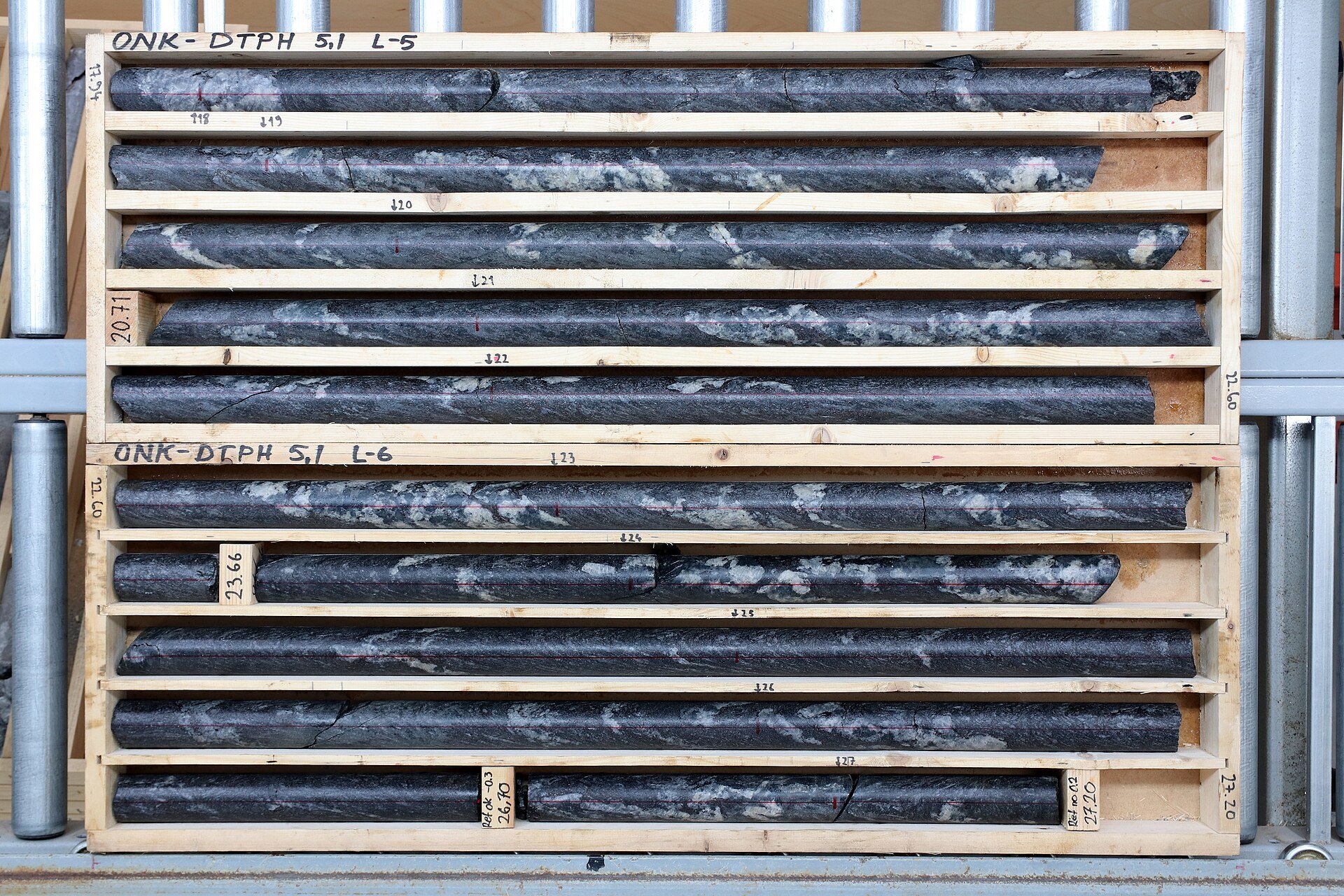
Standard Uranium Ltd. (STND) has released a program-completion and radiometric-summary update for its flagship Davidson River project in the SW Athabasca Basin, Saskatchewan. The release does not constitute an assay report, and no U3O8 grades are reported; all figures provided are handheld scintillometer counts per second (cps).
The drilling program encompassed 6,734 meters across 12 diamond drill holes, designated DR-26-040 through DR-26-051/051A. Drilling occurred between 1 June and the end of September 2026, targeting the Warrior, Bronco, and Thunderbird corridors. One hole, DR-26-051A, was abandoned and subsequently restarted.
Anomalous radioactivity exceeding 300 cps was intersected in only three of the 12 holes, totaling 5.0 meters of composite anomalous width across all intervals. The specific intercepts are as follows:
- DR-26-040 (Bronco, az 080/-65): 0.5 m @ max 300 cps (279.5-280.0 m); 0.5 m @ max 300 cps (397.0-397.5 m); 0.5 m @ max 300 cps (398.0-398.5 m); 0.5 m @ max 1,650 cps (464.0-464.5 m); 0.5 m @ max 540 cps (464.5-465.0 m); 0.5 m @ max 780 cps (465.5-466.0 m).
- DR-26-043 (Thunderbird): 0.5 m @ max 320 cps (356.0-356.5 m).
- DR-26-047 (Bronco): 0.5 m @ max 570 cps (493.0-493.5 m); 0.5 m @ max 550 cps (522.0-522.5 m); 0.5 m @ max 390 cps (543.0-543.5 m).
Holes DR-26-041, -042, -044, -045, -046, -048, -049, -050, and -051 all returned readings below 300 cps. Both Warrior holes, DR-26-049 and -050, were blank.
Geological observations included graphitic faults, shear zones, breccias, cataclasites, fault gouge, and strong fracturing, alongside sericite, dravitic clay, hematite, and quartz-carbonate veining. SWIR/PIMA analysis confirmed the presence of dravitic clay in DR-26-040. The known width of the Thunderbird and Bronco corridors has more than doubled to exceed 300 meters across strike, with the modelled geometry described as matching the stacked shear geometry of the Patterson Lake Corridor.
Whole-rock multi-element geochemistry via ICP-MS/ICP-OES on all holes and U3O8 assays on radioactive zones have been submitted to SRC Geoanalytical Laboratories in Saskatoon. Results are not yet available.
Standard Uranium Ltd. (STND) released results from its Davidson River exploration program on June 15, marking the completion of a drilling campaign that added no new quantitative resource data. The company, a pre-resource explorer and project generator with zero revenue, has drilled 23,295 meters across 51 holes at its flagship site since 2020. To date, no U3O8 assay grades have been reported for the deposit, leaving the geological thesis untested by grade.
The recent release highlighted two new anomalous holes registering between 320 and 570 cps, alongside structural-width and SWIR-clay observations. These findings provide incremental geological context but are considered immaterial in isolation. The data does not introduce new grade or width metrics, serving primarily as a reiteration of the peak results published in June.
The stock has not re-rated since its January-February 2026 trading range of C$0.12-0.13, instead round-tripping to C$0.07 by September 30, 2026. This price point sits at the company’s 52-week low, reflecting a market that prices in essentially zero discovery expectation for Davidson River. Consequently, there is no embedded discovery premium for the release to fail to match, nor is there a basis for a positive reading, as the results do not materially exceed previously demonstrated metrics.
In prior-period context not disclosed in this release, Standard Uranium announced a C$3.0M non-brokered placement on August 7, 2026. The offering was priced at C$0.0765 per unit, totaling 39,215,686 units. This transaction grants a strategic investor approximately 19.7% ownership and a board nomination right, subject to TSXV approval. Against the 159,475,607 shares reported as of July 31, 2026, the placement would increase the total share count to roughly 198.7 million, diluting existing holders by approximately 19.7%.
Analysts expect a flat to modestly negative share-price reaction, citing the limited information content of the four-month-old data and weak hole results. While a 15% or greater move in either direction is unlikely based on substance, the low tick size of C$0.07 means that a single cent represents a 14% change, making headline-level volatility structurally easy to produce.
Standard Uranium Ltd. (TSXV: STND; OTCQB: STTDF; FSE: 9SU0) is a uranium exploration company and self-described "emerging project generator" holding interests in over 110,089 hectares (272,035 acres) in the Athabasca Basin, Saskatchewan. The company currently has no revenue and no mineral resource.
The company’s flagship Davidson River property consists of 10 contiguous dispositions totaling 30,737 hectares in the southwest Athabasca region, located approximately 25 kilometers west of NexGen's Arrow and Paladin's Triple R, and roughly 75 kilometers south of the past-producing Cluff Lake mine. The area features four structural corridors—Warrior, Bronco, Thunderbird, and Saint—and more than 70 kilometers of conductive trends. Since 2020, Standard Uranium has drilled 23,295 meters across 51 holes. Under the terms of the option agreement detailed in the MD&A, $150,000 was paid in July 2026, with the next $150,000 due in July 2027. An additional $200,000 is payable if the company raises more than C$5 million in financing.
In the Eastern Athabasca, the company holds approximately 59,748 hectares, with a presentation citing approximately 45,304 hectares across 37 claims for a subset. This includes the Corvo and Rocas projects, both subject to earn-in option agreements where partners fund exploration while Standard Uranium acts as the operator and earns operator fees. Corvo covers 12,265 hectares and is road-accessible; it features historical surface samples up to 8.10% U3O8 at the Manhattan Showing, which are historical and unverified, and its maiden program is complete as of 2026. Rocas covers 4,002 hectares, with its maiden program also complete in 2026. Historical and 2025 surface results from outcrop grab samples at Rocas showed up to 0.498% U3O8 and up to 9.83% TREO.
The Sun Dog property comprises 19,603 hectares in the historic Uranium City district. Standard Uranium regained 100% ownership after Aero Energy's option agreement concluded in December 2025, and the company is currently seeking a new joint-venture partner.
The company’s business model focuses on acquiring, generating, and optioning properties with partners funding drilling. Revenue-like income is limited to operator fees and option payments, along with receivables from Aventis and Collective Metals as per the MD&A.
Regarding capital structure and liquidity, data from the Q1-FY2027 MD&A to 31 July 2026 indicates 159,475,607 shares outstanding, C$1,010,981 in cash, and C$636,791 in working capital. Total equity stood at C$15.9 million, with a book value per share of approximately C$0.10. The company reported a net loss before tax of C$558,335 for the quarter and included a going-concern disclosure. Fully diluted shares were approximately 198.2 million per the corporate deck, prior to a pending C$3.0 million placement involving 39,215,686 additional units.
Management includes Jon Bey as Chair and CEO, Sean Hillacre as President and VP Exploration (QP), and Vivien Chuang as CFO. The board comprises Blair Jordan, Kenneth Judge, Mike Young, and Doug Engdahl, with Neil McCallum serving as technical advisor.