Revival Gold Reports Additional Infill Results with 2026 Drilling Now 64% Complete at Mercur
Revival’s Mercur infill drilling matched the resource grade without expanding the deposit, while headline grades declined.
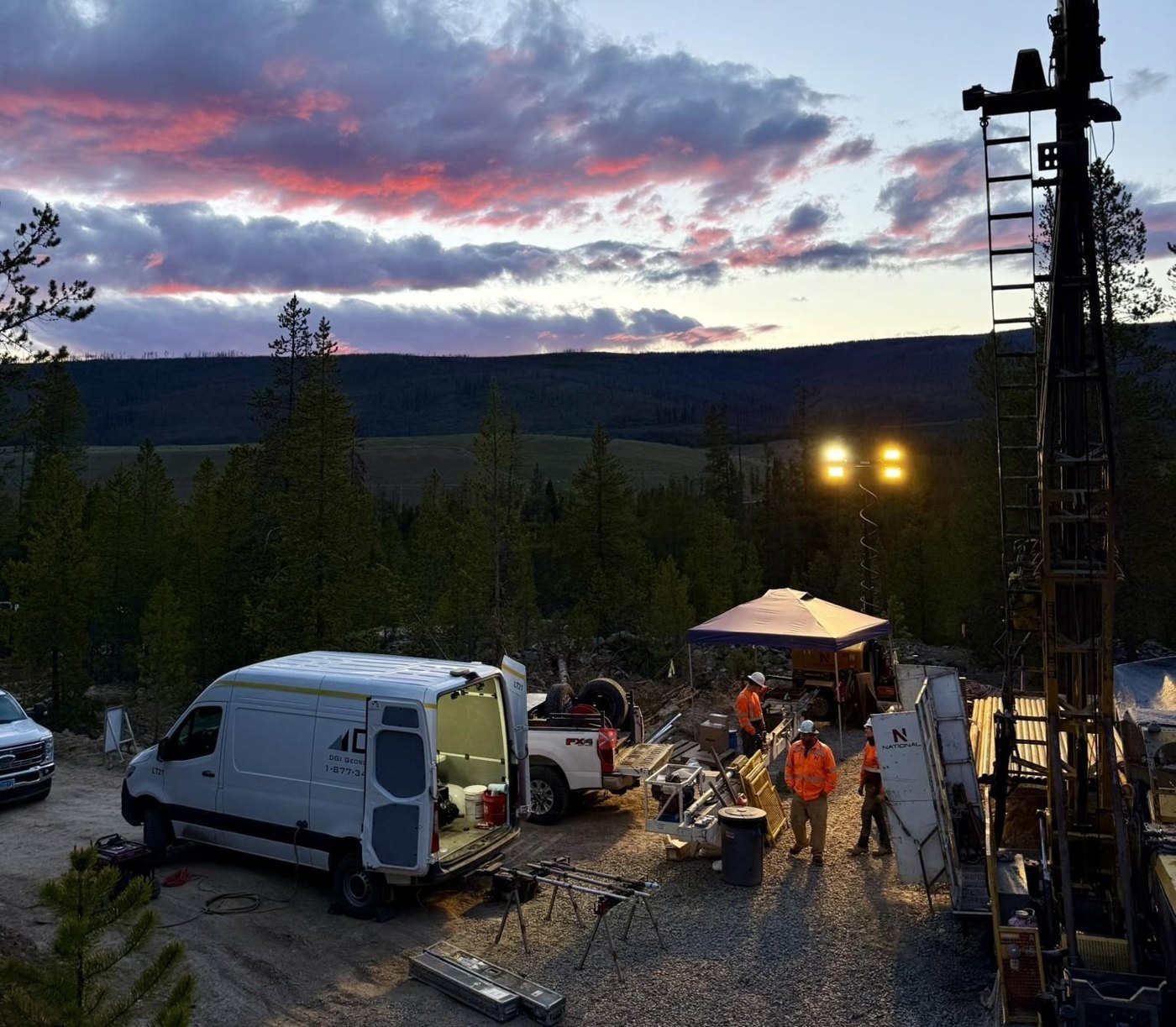
Revival Gold Inc. (RVG) released infill drilling results and a program-progress update for its Mercur Gold Project in Tooele and Utah Counties, Utah, on September 22, 2026. The company stated that approximately 11,600 meters have been completed across 119 reverse circulation and core holes, representing 64% of the planned 2026 program. This disclosure follows previous releases on July 15, 2026, and September 8, 2026, which covered the first 30 infill RC holes. The current update adds results from 20 additional infill RC holes, designated RM26-213 to RM26-232, located in the Main Mercur area.
Four headline intercepts were highlighted, all quoted with true widths qualified at 70-98% of the drilled width. The specific intercepts include:
- RM26-213: 0.92 g/t Au over 33.5 m at 31 m downhole.
- RM26-217: 0.57 g/t Au over 30.5 m at 20 m downhole.
- RM26-220: 0.75 g/t Au over 29.0 m at 26 m downhole.
- RM26-223: 0.76 g/t Au over 22.9 m at 8 m downhole.
Full results for all 20 holes are presented in Table 1, provided as an image link rather than in the release text. The cutoff grade is 0.17 g/t Au, with up to two intervals of internal dilution allowed. Intervals containing no recovery or unassayed material are assigned nil values. While the release notes define the AuCN/AuFA ratio (cyanide-soluble gold to fire-assay gold ratio) and carry it in the table, no numeric values for this metric appear in the body of the text.
Operations at Mercur currently involve three drilling rigs. A fourth auger rig is expected by month-end to conduct an initial investigation of approximately 9 million tonnes of legacy run-of-mine heap leach material across three pads for possible reprocessing.
Sample preparation was conducted by ALS Geochemistry at facilities in Elko, Nevada, and Twin Falls, Idaho. Gold analysis was performed via fire assay/AAS (Au-AA23, 30 g) and cyanide leach/AAS (Au-AA13) for samples exceeding 100 ppb Au, with multi-element analysis conducted via ME-MS 41. The QA/QC program included regular certified reference materials, duplicates, and blanks. ALS Minerals is ISO/IEC 17025:2017 accredited. The qualified persons for the release are John Meyer, P.Eng., EVP Engineering and Development, and Everett Brill, RM SME, Exploration Manager.
Revival Gold Inc. (RVG) released drill results from its Mercur project, describing the data as an infill and resource-definition update for the development-stage company. The Mercur Indicated resource grade stands at 0.66 g/t, while the Inferred resource is 0.54 g/t. Today’s holes averaged approximately 0.76 g/t, meeting or exceeding resource grade over meaningful widths at shallow depths, with good true-width disclosure and adequate QA/QC.
Differences in interval length compared to previous holes RM26-180 and RM26-193 are consistent with an infill programme designed to fill a block model.
Historical market reaction to Mercur infill releases has been modest. Releases on June 25, July 15, and September 8 produced only minor share-price movements. That anchor belongs to the Idaho thesis, not Mercur infill. With Mercur infill not driving the current C$0.88 price, the headline gram-metres are not considered a material negative.
The investment thesis remains unchanged. The 1,372 koz Mercur resource at approximately 0.60 g/t, the 10-year, 95,600 oz/yr heap-leap PEA with an after-tax NPV, and the Q1 2027 PFS timing are all unaffected. The batch of on-grade infill holes advances confidence behind the PEA but does not move the NPV.
The company is capitalized at roughly C$283 million. A 20-hole infill batch confirming grade in a 1.37 moz resource does not meaningfully change perceived scale, grade, or odds. The genuinely new element is the 9 Mt legacy ROM pad investigation, which is unquantified and cannot be priced until assayed.
As a developer with a PEA and a PFS in progress, Revival Gold’s drill results matter primarily insofar as they change reserves, mine life, or economics. This release does not directly alter those factors but de-risks the input to the Q1 2027 PFS.
Prior-period financials for the nine months ended March 31, 2026, show a net loss of C$16.7 million versus C$5.8 million in the prior-year period. The company held cash of C$12.8 million and working capital of C$11.9 million after a C$28.6 million financing. Subsequently, the company closed a C$33.0 million offering at C$0.85 in May 2026, plus approximately C$3.7 million of warrant exercises. Management estimates cash of approximately C$25.3 million at August 31, 2026. There is no revenue and no going-concern flag, but the company continues to rely on equity funding.
Revival Gold Inc. (TSXV: RVG; OTCQX: RVLGF) is a Toronto-headquartered, US-focused gold developer with two wholly owned assets. The company’s Mercur Gold Project is located in Tooele and Utah Counties, Utah, approximately 57 km from Salt Lake City. The site holds a 7,200 ha consolidated position, previously fragmented between Barrick, Homestake and others. The Barrick option was exercised on April 1, 2026 for US$5 million at closing plus US$5 million on each of the first three anniversaries of commercial production, a 2% NSR on the acquired mineral interests and a 1% NSR on adjacent ground within 1 km. Existing infrastructure includes paved road access, 43.8 kV grid power and an inspected substation, a tested water well at 750 gpm versus a 500 gpm operating requirement, and a site office, with no camp required. Historical production at Mercur totals approximately 2.6 moz gold, including roughly 0.9 moz at approximately 7 g/t.
The Mercur 2025 PEA (May 2, 2025) outlines an Indicated resource of 35,299 kt at 0.66 g/t for 746 koz and an Inferred resource of 36,246 kt at 0.54 g/t for 626 koz. The project features a 10-year life averaging 95,600 oz/yr, with pre-production capex of approximately US$208 million and an AISC of approximately US$1,385/oz. Financial metrics include an after-tax IRR of 56% and an after-tax NPV (5%) of approximately US$741-752 million at US$3,000/oz gold. Permitting is expected to take around two years, with a construction decision targeted for 2028, first production for 2029, and a PFS targeted for Q1 2027.
The Beartrack-Arnett project in Lemhi County, Idaho, is a 2023 PFS-stage heap leach restart. It holds a Measured and Indicated resource of 86.2 Mt at 0.87 g/t for 2,423 koz and an Inferred resource of 50.7 Mt at 1.34 g/t for 2,190 koz. Combined Proven and Probable reserves stand at 36.2 Mt at 0.74 g/t for 859 koz. Phase 1 targets approximately 65,300 oz/yr over eight years with an AISC of approximately US$1,248/oz and an after-tax NPV (5%) of approximately US$484 million at US$3,000/oz. The Joss underground sulphide Inferred resource of 6.745 Mt at 4.05 g/t for 877 koz sits outside the 2023 PFS economics and is the current exploration target on the Panther Creek Shear Zone.
The company’s capital structure comprises approximately 321.1 million basic shares and 359.6 million fully diluted shares (presentation, September 2026). Management estimates approximately C$25.3 million of cash at August 31, 2026. Institutional ownership is approximately 59%, with EMR Capital, Dundee Corporation, Sun Valley Gold, Donald Smith and Konwave among the named holders. Prior-period context, not disclosed in today's release, shows that the latest as-reported financials to March 31, 2026 recorded cash of C$12.8 million, working capital of C$11.9 million, a net loss of C$16.7 million for the nine months, and no revenue.
Management and board members carry major-mining pedigree, including Agro (ex-Kinross), Meyer (ex-Perpetua/Kinross/Barrick), Ross (ex-Kirkland Lake), Manini (ex-EMR/Oz Minerals), Hubert (ex-Andean Resources) and Radford (ex-Argonaut).