American Lithium Increases Macusani Uranium Measured and Indicated Resource
American upgrades Macusani MRE resources seven months late while the preliminary economic assessment remains outstanding.
American Lithium Corp. (LI) released a project-level technical update on November 2, 2026, focused exclusively on the Macusani uranium project in Puno, Peru. The disclosure does not constitute an earnings release, financing announcement, or transaction. All figures presented are based on a 100% attributable basis for the Macusani project and do not reflect company-wide data.
The update includes a new Mineral Resource Estimate prepared by Stewart Nupen of Deloitte Consulting (Pty) Ltd, with an effective date of July 1, 2026, and a publication date of November 2, 2026. The resource estimate reports the following intercepts:
- Measured: 10.482 Mt at 179 ppm U3O8 = 4.13 Mlbs.
- Indicated: 111.426 Mt at 216 ppm U3O8 = 53.03 Mlbs.
- Measured + Indicated: 121.908 Mt at 213 ppm U3O8 (180 ppm U) = 57.16 Mlbs U3O8.
- Inferred: 114.873 Mt at 258 ppm U3O8 = 65.32 Mlbs.
The estimate utilizes open-pit cut-offs of approximately 47 ppm U and underground block-constrained cut-offs of approximately 111 ppm U. Economic parameters include a long-term uranium price assumption of US$100/lb U3O8, current Peruvian mining costs, updated processing costs, and metallurgical recovery assumptions. This contrasts with the prior estimate by The Mineral Corporation in March 2015, which used a single 75 ppm U cut-off, 2015 costs, and a US$50/lb U3O8 price assumption. The release attributes the differences between the two estimates to updated reporting requirements under NI 43-101 and S-K 1300, stricter pit and stope constrained reporting, and updated economic constraints, rather than changes to the underlying geological model.
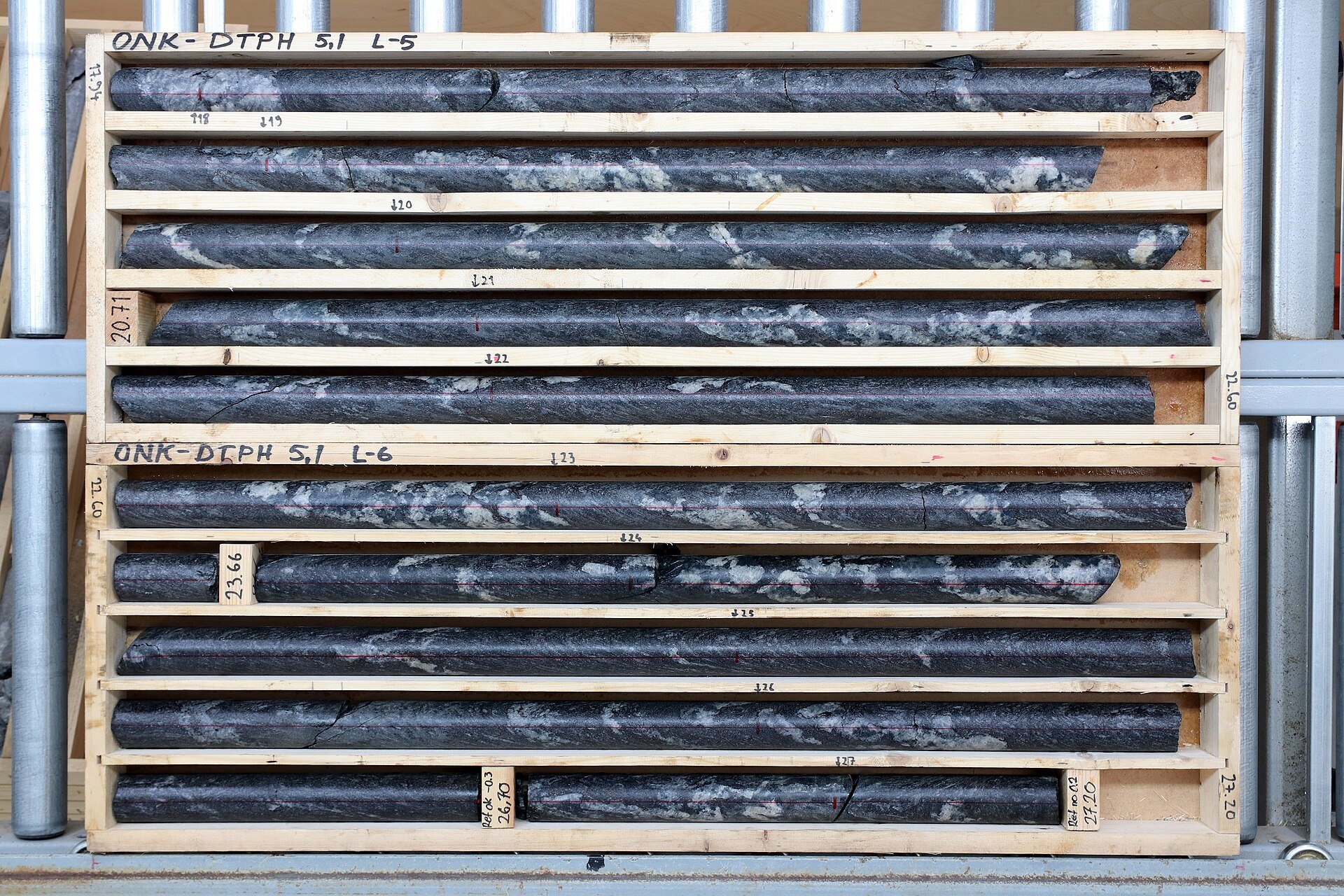
The database supporting the estimate comprises 1,152 diamond holes totaling 114,576 meters, composited to 1.5-meter benches. The resource was modeled using Multiple Indicator Kriging with block models of 50×50×3 meters for well-informed areas and 100×100×3 meters elsewhere, using a density of 1.98 t/m³.
Forward work includes an updated Preliminary Economic Assessment (PEA) that is well underway, followed by expansion and infill drilling, metallurgical piloting, and a Pre-Feasibility Study. The company cited over 40 undrilled uranium surface occurrences. CEO statements reiterated the intention to place Macusani into a stand-alone uranium company. The NI 43-101 technical report is scheduled to be filed on SEDAR+ within 45 days.
The release does not contain PEA economics such as NPV, IRR, capex, opex, mine life, annual production, or recovery rates. It also excludes a side-by-side comparison of the new MRE against the 2015 MRE tonnage, grade, or contained metal, any permitting milestones, any reserve estimates, any financing plans, and any terms, ratios, record dates, venues, or timetables for the spin-out.
American Lithium Corp. (LI) released an updated Mineral Resource Estimate (MRE) for the Macusani project on November 2, 2026, marking the completion of one of two studies commissioned by Deloitte and DRA Global on December 16, 2025. The initial announcement had targeted results for the first quarter of 2026, but the company subsequently revised the timeline in its August 2026 Management’s Discussion and Analysis to "by end of 2026." The second deliverable, a Preliminary Economic Assessment (PEA), remains outstanding and is now due within approximately eight weeks.
The updated MRE reports a classification shift that increases the proportion of the resource categorized as Measured and Indicated. The estimate identifies 57.16 million pounds of contained uranium in the Measured and Indicated category, with an additional 122.5 million pounds included in the Inferred category. The Inferred category accounts for 65.32 million pounds, representing more than half of the total contained metal. The company did not provide a comparative table from the 2015 estimate, preventing independent verification of whether the total contained metal volume has increased.
The resource grade is reported at 213 parts per million U3O8, equivalent to 0.0213% U3O8 or approximately 0.43 pounds per short ton of rock. The estimate utilizes a uranium price assumption of US$100 per pound, a doubling of the US$50 per pound assumption used in the 2015 estimate. Under the current price deck, cut-offs were relaxed for open-pit mining from 75 ppm to approximately 47 ppm U. The company noted that sensitivity analysis is not disclosed; however, at lower price decks, underground material with an 111 ppm U cut-off would likely be excluded, as it constitutes a meaningful portion of both the Indicated and Inferred categories.
The MRE was prepared by an independent, internationally recognized Qualified Person and is compliant with both NI 43-101 and SEC S-K 1300 standards. The report includes explicit Reasonable Prospective Eventually Economical (RPEEE) constraints and audited quality assurance and quality control (QA/QC) protocols. The company stated that metallurgical piloting is listed as future work, meaning the flowsheet and recovery rates required for a bankable economic assessment have not yet been validated.
The release did not disclose any royalty or streaming agreements associated with the Macusani project. Whether the asset is royalty-free remains unknown based on the provided materials.
American Lithium’s operational progress on the Falchani pilot plant, fully commissioned on September 16, 2026, reported a lithium extraction rate of 88.7%, an improvement over the 80.0% extraction rate cited in the February 2024 Preliminary Economic Assessment. This data point pertains to the lithium business line rather than the Macusani uranium project.
Recent corporate developments include the Supreme Court Resolution No. 24 on December 3, 2025, which granted full ownership of 32 concessions, serving as a legal precondition for the spin-out announced on December 16, 2025. On February 3, 2026, the interim CEO was made permanent, and an option cleanup cancelled 1,835,800 options at strike prices of $3.63 and $4.85. These options were deep out of the money at the time, as the share price was $0.34, resulting in no cash effect. Additional context includes DIBC membership on May 26, 2026, Peru's Supreme Decree declaring uranium and lithium of national importance on June 2, 2026, and commentary regarding the Fujimori election on July 7, 2026.
American Lithium Corp. is a pre-revenue development-stage company holding three advanced-stage critical-minerals assets, all with completed preliminary economic assessments (PEAs). The Falchani project in Puno, southern Peru, is a hard-rock lithium deposit marketed as one of the world's largest hard-rock lithium deposits and hosting a globally significant cesium resource. It serves as the company's flagship asset, carrying the operational news flow which includes a February 2024 PEA showing 80% recovery, a pilot plant commissioned in September 2026 at 88.7% extraction, and a target of battery-grade >99.5% Li2CO3.
The company also holds the TLC claystone lithium project in Nevada, USA, which it tied to its May 2026 Defense Industrial Base Consortium (DIBC) membership. Additionally, American Lithium Corp. holds the Macusani uranium asset in Puno, Peru, described as the largest known undeveloped uranium project in South America. This asset was previously covered by a March 2015 PEA and is now covered by the 1 July 2026 Deloitte MRE. The Macusani project is slated for spin-out.
There are no mineral reserves at any project, no revenue, no production, and no permits to mine. All three assets remain at the PEA stage, not feasibility studies. The corporate narrative in 2026 has focused on legal de-risking in Peru in December 2025, leadership stabilization in February 2026, pilot-scale metallurgical validation at Falchani in September 2026, and the separation of the uranium asset. The company has no operating history to benchmark against and an 11-year gap between Macusani MREs from 2015 to 2026.