AGNICO EAGLE REPORTS THIRD QUARTER 2026 RESULTS - STRONG FREE CASH FLOW GENERATION DRIVEN BY SOLID OPERATIONAL PERFORMANCE; ON TRACK TO ACHIEVE 2026 PRODUCTION AND COST GUIDANCE
Agnico Eagle reported third-quarter results with all-in sustaining costs at the high end of guidance and free cash flow declining 28% year over year.
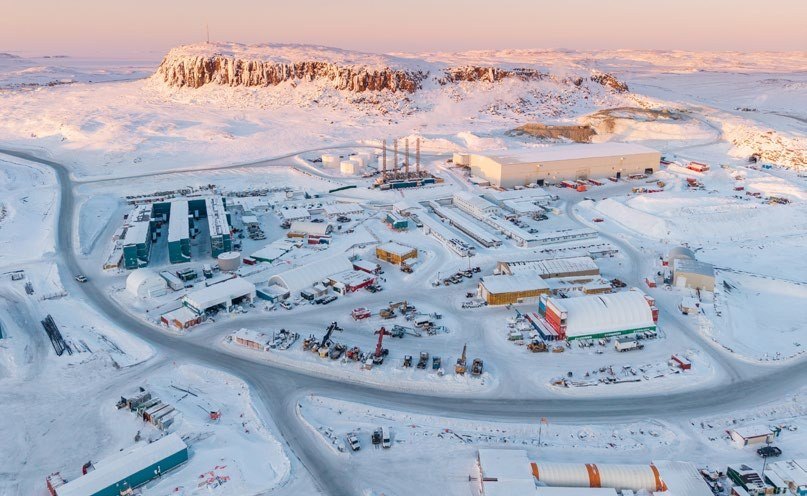
Agnico Eagle Mines Limited reported third-quarter 2026 payable gold production of 814,012 ounces, with production costs of $1,193 per ounce, total cash costs of $1,133 per ounce, and all-in sustaining costs (AISC) of $1,648 per ounce. The company posted net income of $1,353 million, or $2.67 per share, while adjusted net income stood at $1,324 million, or $2.62 per share. EBITDA reached $2,445 million, supported by operating cash flow of $1,755 million and free cash flow of $852 million, or $1.68 per share.
The realized gold price for the quarter was $4,264 per ounce. Agnico Eagle returned $478 million to shareholders through a $0.45 per share dividend and the repurchase of 1,297,940 shares at an average price of $192.60, totaling approximately $250 million. Cash reserves increased by $149 million to $3,613 million, resulting in a net cash position of $3,416 million against total debt of $197 million. The company also upsized its $2 billion revolving credit facility to $3 billion and extended the maturity date to October 28, 2031.
Full-year 2026 guidance remains unchanged in range but is positioned toward the weaker end of the spectrum. Production is expected near the lower end of the 3.3–3.5 million ounce range, total cash costs near the upper end of $1,020–$1,120 per ounce, and AISC near the upper end of $1,400–$1,550 per ounce. The quarter’s AISC of $1,648 per ounce exceeded the annual guidance ceiling, and free cash flow declined sharply both year-over-year and quarter-over-quarter.
Project execution updates highlighted several milestones. The first phase of the Odyssey shaft is complete, with shaft production planned for the second quarter of 2027. Underground ramp development at Detour has reached 207 meters, while the Upper Beaver shaft is at 732 meters. Construction at Hope Bay is 13% complete with detailed engineering at 73%, and approval for the San Nicolás project is now expected in late 2027 or early 2028.
Agnico Eagle Mines Limited (AEM) released its latest financial results, which largely confirm the production and cost guidance revisions management pre-announced on July 2 and reiterated during the second-quarter earnings call. The company reduced its 2026 production forecast to the low end of its range and raised its cost estimates to the high end. The market has had several months to digest these changes, and the release did not introduce any new material negative events such as a takeover, major acquisition, tier-one reserve expansion, new strategic shareholder, dividend cut, executive departure, or a fresh guidance cut.
The report highlighted some challenges in operational delivery. Third-quarter all-in sustaining costs (AISC) came in at $1,648/oz, exceeding the full-year guidance ceiling. Production fell 6.1% year over year, and free cash flow declined 28% year over year and 36% quarter over quarter, despite a 22.7% increase in realized gold prices.
However, the company also reported strong financial performance in other areas. Net income, EBITDA, and per-ounce margins all expanded significantly year over year. Agnico Eagle maintains a net cash balance sheet, and its project pipeline remains on schedule. Given the stock’s recovery from its July low and the absence of new downward guidance, the release is viewed as expected and modestly negative rather than a significant shift in the company’s outlook.
Agnico Eagle Mines Limited (AEM) is a multi-mine gold producer listed on the NYSE and TSX, with operations spanning Canada—including Quebec, Ontario, and Nunavut—as well as Finland, Australia, and Mexico. The company’s primary commodity is gold, with silver, copper, and zinc produced as by-products. Its portfolio is weighted toward politically stable jurisdictions, with Canada serving as the largest operating base.
Producing assets include Canadian Malartic/Odyssey, LaRonde, Goldex, Akasaba West, Detour Lake, Macassa, Meliadine, Meadowbank/Amaruq, Fosterville, Kittila, and the 50%-owned San Nicolás joint venture with Teck. Development and growth assets include Hope Bay, Upper Beaver, East Gouldie, Detour Lake underground/West Extension, and the newly consolidated Finland assets, including Ikkari.
The company has a long operating history, pays a dividend, and utilizes a net-cash balance sheet alongside a Normal Course Issuer Bid (NCIB) to return capital. It also takes strategic equity stakes in junior companies, a activity described as portfolio management rather than a core producing asset.