Champs d'Or en Beauce : Les Forages de Phase 1 Confirment la Continuite d'Une Importante Zone Aurifere Peu Profonde a Grondin, Incluant 5,0 m a 1,90 g/t Au et 1,0 m a 6,59 g/t Au
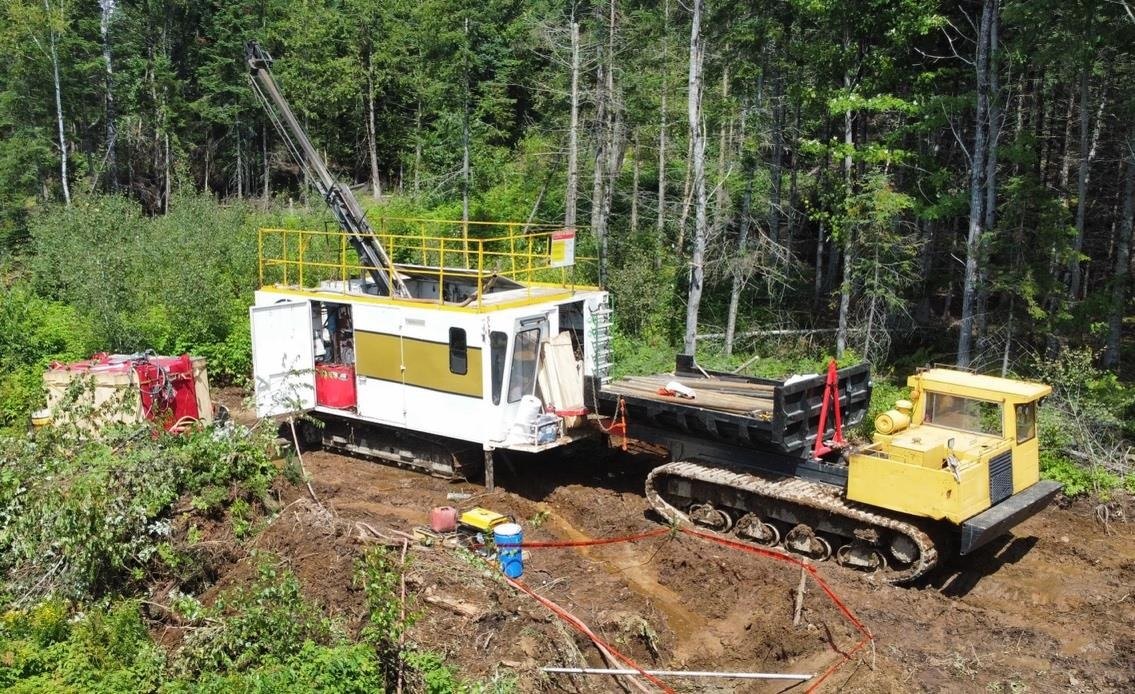
Beauce Gold Fields Inc. (TSX: BGF) has announced the results of Phase 1 of its 2026 diamond drilling program at the Grondin zone of its Beauce Gold Project in Quebec. The drilling confirmed the continuity of gold mineralization within the Saddle Reef-type antiform system previously identified in 2023 and 2025, supporting the interpretation of a structurally controlled, open-ended gold system associated with the Beauce paleoplacer district. Significant intercepts were reported in holes GR-26-03 and GR-26-05, validating the structural model and guiding the roadmap for Phase 2 drilling, which will focus on extending the mineralized corridor and testing new geophysical targets.
Phase 1 consisted of six diamond drill holes totaling approximately 600 meters, designed to test depth continuity of known mineralized zones and evaluate induced polarization (IP) geophysical targets. Hole GR-26-03 intercepted a wide mineralized interval of 27.0 m at 0.60 g/t Au from 21.0 m to 48.0 m. This interval included 10.0 m at 1.30 g/t Au from 21.0 m to 31.0 m, and 1.0 m at 6.59 g/t Au from 22.0 m to 23.0 m. The hole was terminated at 48.0 m due to a fault and casing issue; it is planned to be re-drilled in Phase 2 to test beyond the fault zone.
Hole GR-26-05 intercepted gold mineralization 9.5 m at 0.24 g/t Au from 57.0 m to 66.5 m. This result included 4.0 m at 0.39 g/t Au from 60.5 m to 64.5 m, and 1.0 m at 0.95 g/t Au from 61.0 m to 62.0 m. This result supports the interpretation that the system remains open along the axis and that IP-guided drilling can extend the mineralized corridor southwest of the Grondin zone.
Other holes in the program returned negative results. Holes GR-26-01 and GR-26-02 tested IP anomaly PP-1 but did not intersect the interpreted structure or return significant gold grades. Hole GR-26-06, drilled to test the known structure in GR-25-08, also failed to intersect the target zone, suggesting the zone may be more tightly folded to the southwest. Hole GR-26-04 did not intersect the targeted structure.
The mineralized zone consists of grey to black argillite with fine to coarse lapilli textures, white quartz veins, and sulfides (5-10% pyrite). High-grade gold is associated with sulfides and free gold, particularly in semi-massive pyrite, indicating potential "nugget effect" variability. The known sector is interpreted to be open laterally and in depth, with the mineralized corridor potentially extending for several kilometers. The antiform structure is interpreted as a likely bedrock source for the historical Beauce placer gold deposits.
Patrick Levasseur, President and CEO, said: "We are very satisfied with the Phase 1 results, which continue to validate the Grondin zone as a shallow, structurally controlled Saddle Reef-type gold system. Hole GR-26-03 is a significant step: it intercepted a wide mineralized interval with higher-grade sub-intervals... Hole GR-26-05 is also important as it intercepted gold mineralization southwest of the Grondin zone, supporting our interpretation that the system remains open along the axis... These results give us a clearer roadmap for Phase 2: refine the structural model, continue or resume drilling GR-26-03 beyond the fault zone, and test other targets along the interpreted antiform corridor."
Phase 2 drilling plans include continuing or resuming drilling GR-26-03 beyond the fault zone, testing IP anomaly PP-2, conducting additional lateral geophysical surveys along the structure to the northeast, and refining the structural model to target higher-grade Saddle Reef-type mineralization. Samples were analyzed for gold by PhotonAssay at MSALABS in Val-d’Or, Quebec. Certificates YVO2610875 and YVO2610961 are referenced.