Canadian Gold Resources Ltd. Reports High-Grade Gold Intercepts from the 2025/2026 5 Lac Arsenault Drill Program
Canadian drilled 81 holes and 2,712 assays for approximately 90 g·m of gold, providing results that do not support the bulk-tonnage thesis.
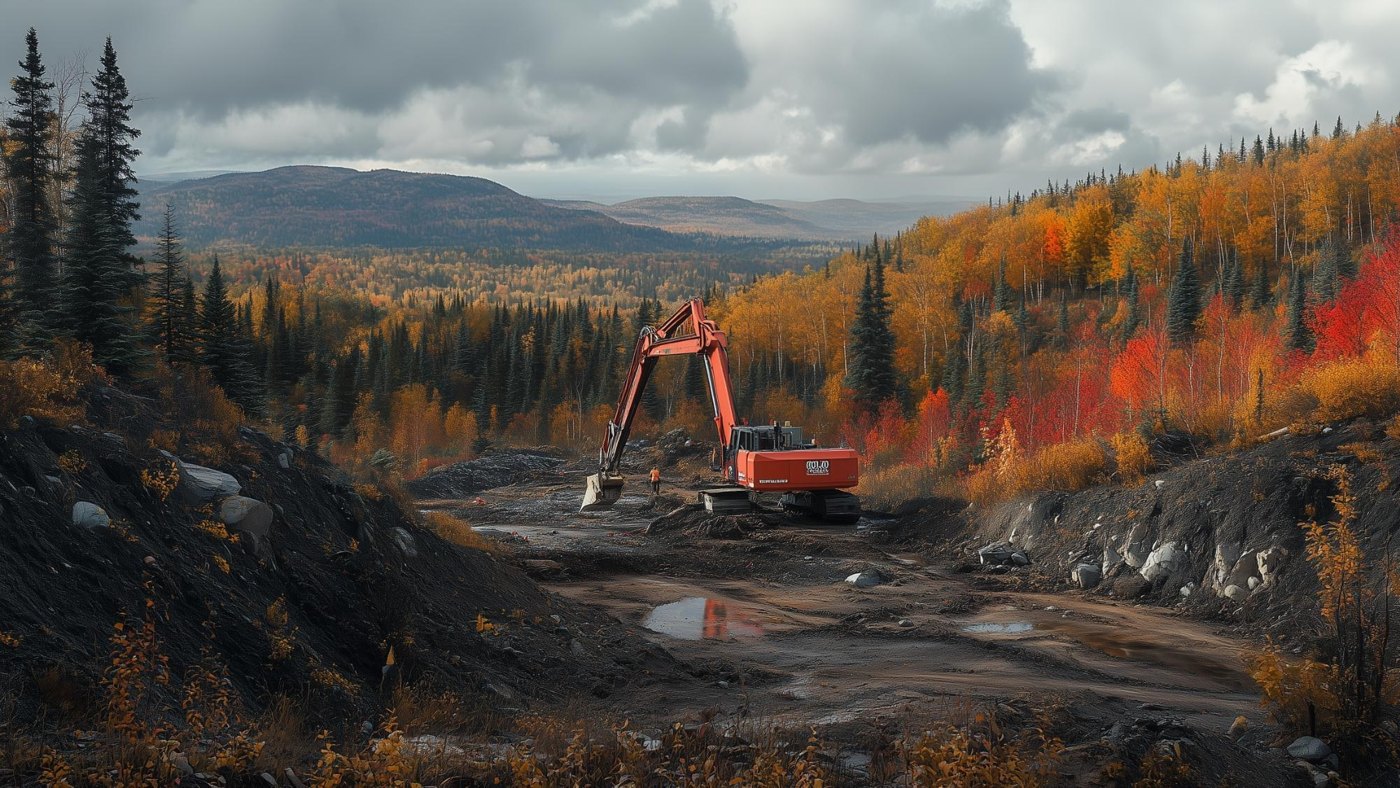
Canadian Gold Resources Ltd. (CAN) released selected assay results from the 2025/2026 diamond drilling program at the Lac Arsenault property, located in Gaspé, Québec. The program targeted the Baker and Mersereau quartz-sulphide veins. In total, 81 holes were logged and sampled, with an additional 10 holes drilled but left unlogged. The company assayed 2,712 samples, disclosing results from 17 holes containing approximately 20 intervals in Table 1.
The reported results are downhole lengths, with no true widths or per-interval cutoffs stated. Highlights from the program include:
- LAC-25-BM-001: 19.50 g/t Au over 1.00 m from 30.35 m — flagged as previously reported March 3, 2026, and led in the headline list
- LAC-25-BM-002: 7.01 g/t over 1.20 m from 42.25 m
- LAC-25-BM-010: 5.30 m @ 1.97 g/t from 46.00 m, incl. 0.50 m @ 5.31 and 0.40 m @ 15.00
- LAC-25-BM-046: 1.35 m @ 6.01 g/t from 38.25 m, incl. 0.60 m @ 11.75
- LAC-25-BM-035: 2.40 m @ 3.16 g/t from 62.30 m, incl. 0.85 m @ 6.11
- LAC-25-BM-077: 0.40 m @ 13.25 g/t from 58.55 m
- LAC-25-BM-003: 2.85 m @ 2.11 g/t, incl. 1.45 m @ 4.00
- LAC-25-BM-009: 1.25 m @ 1.56 g/t, incl. 0.30 m @ 5.32
- LAC-25-BM-053: 2.30 m @ 0.94 g/t, incl. 0.30 m @ 5.32
- LAC-25-BM-088: 1.40 m @ 0.97 g/t and separately 0.60 m @ 5.07
- Single-sample hits: BM-008 0.25 m @ 8.63; BM-065 0.30 m @ 6.70; BM-078 0.35 m @ 5.28; BM-082 0.65 m @ 5.12; BM-083 0.40 m @ 6.37 (at 111.90 m depth); BM-084 0.40 m @ 6.05; BM-089 0.35 m @ 5.86
Management noted that all intervals exceeding a 0.3 g/t Au screening grade fall within a 2020 IP chargeability anomaly. Two domains, designated Upper and Lower, were interpreted from cross-sections. While silver, lead, and zinc were analyzed, no values for these elements were provided. The company acknowledged that the holes were drilled northwest, whereas the veins dip moderately to steeply west/southwest. Consequently, the program may not have optimally tested the distribution, density, and continuity of the veins. Future work is planned to drill eastward and merge the 2025/2026 IP survey with the 2020 IP data.
Canadian Gold Resources Ltd. (CAN) is a pre-resource explorer with no NI 43-101 resource and no revenue. As of June 30, 2026, the company held $87,942 in cash and reported a working capital deficit of $442,891. Total assets stood at $6.53 million, with 86% classified as capitalized intangibles totaling $5.63 million.
The company’s recent release addressed the pending assays for 82 drill holes, converting that optionality into delivered data. The results describe a narrow-vein, high-grade-in-slivers system, with the best hole being the one already reported in March. The stated objective of a 0.3 g/t-screened open-pit resource lacks supporting intervals in 81 of the holes. Management has conceded that the drill orientation was incorrect and that the veins were not properly tested, indicating the program was geometrically compromised and necessitating a re-drill rather than a resource build.
The 19.5 g/t hole was published on March 3, 2026, when the stock traded at $0.14. The stock is now $0.04, down 71% since that date, with a 52-week high of $0.24 on January 23 and a 52-week low of $0.03 on November 13. The market has largely discarded the discovery. The release indicates no bulk-tonnage halo was found; the widest interval in the entire program is 5.3 meters.
On October 22, the company reduced its bulk sample size from 5,000 tonnes to 500–1,000 tonnes "to allow for more selective extraction," following a review of the same assay data. This represents an 80–90% reduction in the only test the company had of grade continuity and metallurgy. These disclosures suggest the company could not define 5,000 tonnes of mineralized rock, and 81 holes could not define a bulk envelope.
The balance sheet presents significant funding challenges. With $88,000 in cash, a $443,000 working capital deficit, and a flow-through obligation to spend $1,116,095 by December 31, 2026, a re-drill must be funded by additional equity. The company has 58.9 million shares outstanding, plus approximately 23.3 million warrants, approximately 2.25 million options, and up to 20 million new placement units and 20 million new warrants. The fully diluted share count is heading toward approximately 120 million against a market capitalization of approximately C$2.4 million.
The stock is expected to trade flat-to-down 10–25% on this release, likely within a $0.03–$0.04 range. The practical floor is set by the $0.05 placement price, which sits above the current market price.
Canadian Gold Resources Ltd. (TSXV: CAN) is an early-stage gold explorer with three 100%-owned properties totalling approximately 29,225 hectares (514 claims) on Québec's Gaspé Peninsula along the Grand Pabos–Garin River fault corridor.
The company’s flagship Lac Arsenault property features an Au-Ag-Pb-Zn(±Sb) quartz-sulphide vein system with historic underground workings. A total of 92 holes have been drilled across the maiden and 2025/2026 programmes. The company originally permitted a 5,000 t bulk sample, which has since been reduced to 500–1,000 t. There is no NI 43-101 resource. Historic non-compliant estimates from 1975 (40,000 t @ 15.43 g/t) and 1996 (199,580 t @ 9.59 g/t) are provided for context only.
The Robidoux property hosts vein-type gold along the Grand Pabos fault. Historic intercepts include 92.0 g/t over 1.70 m, 45.9 g/t over 3.10 m, and a 400 t bulk sample averaging 31.54 g/t, all of which are pre-43-101. A maiden drill programme is targeted for fall 2026, pending permits and financing.
The VG Boulder property is in the precious-metal and antimony reconnaissance stage. Surface boulder samples returned 75.7 g/t Au in 2021 and 22.4 g/t Au with 15.4% Sb. The property has not been drill-tested.
Financial position data from the six months ended June 30, 2026, shows a net loss of $432,581. Exploration and evaluation spend was $624,354, and SG&A was $389,017. The company held cash of $87,942 and a working capital deficit of $442,891. Total equity stood at $5,485,936, of which $5,634,805 was capitalized intangibles. Funding is entirely equity-based, with a $1,116,095 flow-through expenditure obligation due by December 31, 2026.
The share count increased from 54.87M on June 30 to 58.07M on July 29, and 58.94M per this release. This follows a November 6 placement of up to 20M units plus 20M warrants, on top of approximately 23.3M existing warrants and approximately 2.25M options. Management has churned through four QPs and three CEO titles within the year.