Edge Copper Discovers Large Copper-Gold-Silver-Molybdenum Porphyry System Beneath Zonia Oxide Deposit
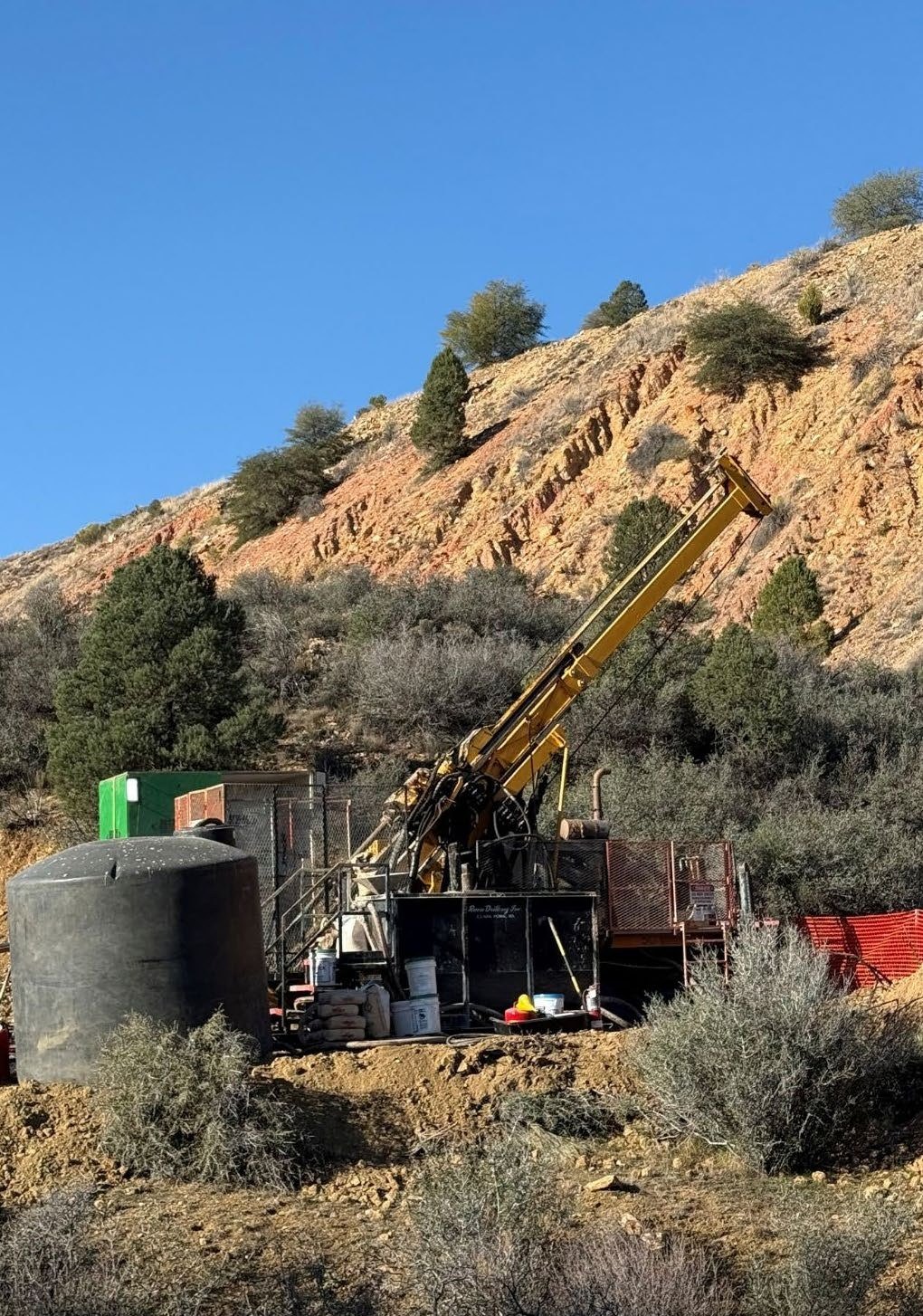
Edge Copper Corporation (EDCU) announced the discovery of a large hypogene copper-gold-silver-molybdenum porphyry system beneath its existing Zonia oxide deposit in Arizona. The company reported that all 13 holes drilled below the oxide deposit intersected sulfide mineralization along approximately 9,800 feet of strike length, with seven holes extended to test the system at depth. Induced polarization (IP) surveys indicate the chargeability footprint is significantly larger than the drilled area, extending approximately 16,400 feet along strike and 3,300 feet wide at 2,000 feet depth.
The discovery scale is defined by 13 holes intersecting sulfide mineralization over approximately 9,800 feet (2,980 meters) of strike length. IP surveys outline a chargeability footprint approximately 16,400 feet (5,000 meters) long and 3,300 feet (1,000 meters) wide at 2,000 feet (600 meters) depth. Approximately 60% of the strike length has been tested by widely spaced drilling. Of the 13 holes reported, seven were extended to test sulfide mineralization at depth, while six were oxide definition holes stopped shortly after entering sulfide.
Significant sulfide intervals were defined using a cutoff grade of 0.15% Total Copper (CuT), with higher-grade "including" intervals defined at 0.30% CuT. Oxide intervals utilized a cutoff of 0.10% CuT. True thicknesses have not been determined, and reported intervals are down-hole lengths. Assays were performed by Skyline Assayers and Laboratories in Tucson, Arizona, using a single-element assay method with three-acid digestion followed by atomic absorption spectroscopy (AAS). Quality assurance and control included certified reference materials, blanks, and duplicate samples inserted at regular intervals.
Significant drill intercepts for sulfide mineralization include:
- ZND0063: 876 ft at 0.38% CuEq (0.26% CuT, 0.10 g/t Au, 1.29 g/t Ag, 62 ppm Mo) from 1,075 ft to end of hole (1,951 ft).
- Including: 80 ft at 0.57% CuEq from 1,715 ft.
- Including: 40 ft at 0.70% CuEq from 1,825 ft.
- Note: Hole ended in mineralization when drill rods tightened.
- ZND0068: 423 ft at 0.50% CuEq (0.34% CuT, 0.14 g/t Au, 1.04 g/t Ag, 91 ppm Mo) from 469 ft to end of hole (892 ft).
- Including: 71 ft at 0.64% CuEq.
- Including: 113 ft at 0.62% CuEq.
- ZND0058: 775 ft at 0.34% CuEq (0.24% CuT, 0.08 g/t Au, 1.83 g/t Ag, 49 ppm Mo) from 1,260 ft.
- Including: 90 ft at 0.55% CuEq.
- Including: 50 ft at 0.67% CuEq.
- ZND0060: 50 ft at 0.69% CuEq from 1,198 ft; and 499 ft at 0.36% CuEq from 1,289 ft.
- Including: 70 ft at 0.47% CuEq.
- ZND0019: 416 ft at 0.41% CuEq (0.26% CuT, 0.14 g/t Au, 1.77 g/t Ag, 35 ppm Mo) from 886 ft to end of hole (1,302 ft).
- Including: 80 ft at 0.51% CuEq.
- Including: 20 ft at 1.01% CuEq.
Other notable sulfide intercepts included:
- ZND0001: 174 ft at 0.43% CuEq from 442 ft.
- ZND0002: 140 ft at 0.33% CuEq from 653 ft.
- ZND0006: 190 ft at 0.31% CuEq from 665 ft.
- ZND0013: 131 ft at 0.53% CuEq from 510 ft.
- ZND0027: 237 ft at 0.50% CuEq from 889 ft.
- ZND0031: 120 ft at 0.28% CuEq from 810 ft.
- ZND0032: 72 ft at 0.38% CuEq from 800 ft.
- ZND0014: 86 ft at 0.27% CuEq from 753 ft.
- ZND0019: 20 ft at 0.31% CuEq from 756 ft; 30 ft at 0.24% CuEq from 826 ft.
- ZND0058: 53 ft at 0.27% CuEq from 1,147 ft.
- ZND0060: 90 ft at 0.23% CuEq from 1,818 ft.
- ZND0063: 138 ft at 0.37% CuEq from 277 ft; 150 ft at 0.29% CuEq from 565 ft; 140 ft at 0.28% CuEq from 745 ft; 120 ft at 0.29% CuEq from 925 ft.
Oxide intercepts included:
- ZND0063: 277 ft at 0.33% CuT from surface (previously reported).
- ZND0068: 155 ft at 0.29% CuEq (0.29% CuT) from 200 ft.
Geophysical data from two IP and resistivity surveys covering Zonia, combining historical lines from 2018 and recent lines from 2026, were processed in 3D inversion by Mira Geoscience. The results show a single coherent chargeable body striking northeast-southwest. Sulfide mineralization is not included in the 2026 Preliminary Economic Assessment (PEA), and no Mineral Resource has been estimated for the sulfide system.
"This is a major discovery at Zonia," said Gil Clausen, Chair and CEO of Edge Copper. "Every hole drilled below the oxide deposit intersected sulfide mineralization, several of the deepest holes ended in mineralization, and the geophysics indicates the system extends well beyond the drilling completed to date. We now have a compelling foundation to evaluate the scale and higher-grade zones of this newly recognized Cu-Au-Ag-Mo porphyry system while continuing to advance the oxide project."
Dr. Patrick Redmond, Ph.D., P.Geo., Qualified Person and exploration consultant to Edge Copper, stated, "The higher-grade Cu-Au-Ag-Mo mineralization at Zonia is associated with abundant A-quartz veins and intense potassic alteration, the same assemblage that characterizes the high-grade cores of many classic porphyry copper systems worldwide. We see this style in multiple holes, and ZND0063, the deepest hole by vertical depth, ended in the same style of mineralization. Together with the geophysics, the drilling indicates a large sulfide porphyry system with multiple centres and localized higher-grade Cu-Au-Ag-Mo zones within a broader mineralized envelope. The system remains open laterally and at depth."
Edge Copper plans to complete the remaining oxide drill program by mid-November. Future work includes refining boundaries using sequential copper analyses and core scanning, advancing metallurgical test work, and progressing technical work for an updated Mineral Resource estimate for the oxide deposit in Q1 2027. The company will also integrate data into a geological model of the sulfide system and plan systematic deeper drilling in 2027.