BP Silver Corp. Returns 1,328 g/t Silver Equivalent over 3.0 Meters at Pocanita Chica Target - Discovers Significant Feeder Structure
BP reports a 1,328 g/t AgEq grade at its project, though the result is driven primarily by bismuth and antimony rather than silver.
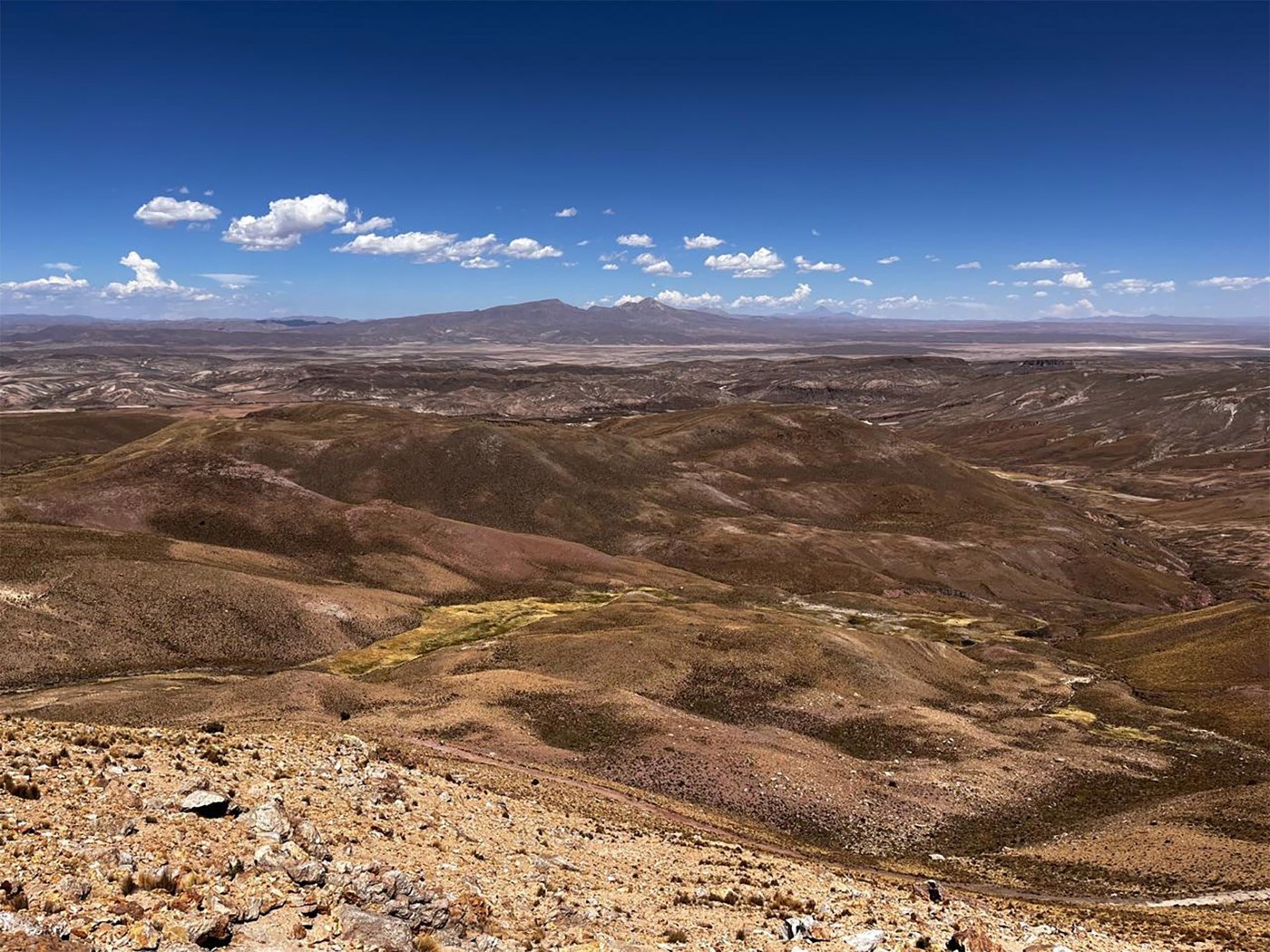
BP Silver Corp. (BPAG) has released assay results from the first two holes of its Phase 2 drilling program at the Pocañita Chica target of the Cosuño silver project in Bolivia. The company describes hole CO-0013 as the best hole drilled to date at Cosuño.
Key intercepts from the drilling include:
- Hole CO-0013 reported 3.0 m (from 56.0 to 59.0 m) grading 314.3 g/t Ag, 2.62% Bi, 0.74% Sb = 1,328.8 g/t AgEq.
- That 3.0 m sits within 7.0 m (56–63 m) @ 168.8 g/t Ag, 1.20% Bi, 0.35% Sb = 634.1 g/t AgEq.
- That in turn sits within 74.0 m (16–90 m) @ 31.7 g/t Ag, 0.13% Bi, 0.04% Sb = 82.3 g/t AgEq — the release notes this is ~65% of the 115.0 m hole.
- An additional nested interval: 10.0 m (56–66 m) @ 127.7 g/t Ag, 0.86% Bi, 0.25% Sb = 461.3 g/t AgEq, and 3.0 m (34–37 m) @ 51.8 g/t Ag = 99.1 g/t AgEq.
- Hole CO-0012 reported 37.0 m (9.5–46.5 m) @ 27.3 g/t Ag, 0.02% Bi, 0.02% Sb = 39.3 g/t AgEq; 30.0 m (59.5–89.5 m) @ 25.6 g/t Ag = 27.6 g/t AgEq; 20.0 m (104.5–124.5 m) @ 31.0 g/t Ag = 31.5 g/t AgEq; 5.0 m (116.5–121.5 m) @ 75.4 g/t Ag = 75.9 g/t AgEq.
Intervals were calculated using a cutoff of 10 g/t Ag, with sub-intervals at 30, 60, and 90 g/t Ag. All reported intervals represent core lengths; true widths have not been determined.
The AgEq formula utilized US$38.00/oz Ag, US$20.00/lb Bi, and US$25.00/lb Sb, based on USGS 2025 averages, alongside recoveries of 93.10% Ag, 85.3% Bi, and 80.9% Sb borrowed from Argenta Silver's El Quevar NI 43-101. Because maximum Sb values in CO-0008 and CO-0013 exceeded the 10,000 ppm ICP detection limit and were capped at 1.0%, the reported Sb averages and AgEq figures are stated as minimums.
Exploration status shows 19 holes completed for a total of 2,289.7 m, with a minimum of eight more planned. Seventeen assay sets remain pending. A drone MAG survey is complete over 37.54 km², an IP survey is underway, and 699 surface samples have been collected.
BP Silver Corp. (BPAG) is a pre-revenue explorer with a C$63 million market capitalization, or C$80 million fully diluted based on 85.28 million shares. The company reported cash of C$9.55 million as of June 30, 2026, according to as-reported statements, while an investor presentation indicated approximately C$8.7 million as of September 1, 2026. For the nine months ended June 30, 2026, the company posted a net loss of C$2,845,248 and an operating cash outflow of C$2,953,941. At this burn rate, the company has roughly two years of runway before requiring further capital raises.
In March and April 2026, BP Silver raised approximately C$10.2 million across tranches at C$1.00 per share, accompanied by half-warrants exercisable at C$1.30. This pricing leaves that cohort roughly at breakeven to underwater at the current price of C$0.94. The stock traded from approximately C$0.82 prior to the publication of the Phase 1 bonana anchor, CO-0008, on February 27, 2026, to a closing high of C$1.32. It has since round-tripped to C$0.94, which is roughly 15% above its pre-anchor level and 29% below the March closing high. Additionally, the stock drifted from C$1.15 on August 18, 2026, to C$0.94 on September 28, 2026, an 18% decline into the release with no negative news.
The recent drilling results do not establish a resource, confirm tonnage, or provide metallurgy. However, the results confirm that a high-grade silver-bearing structure persists approximately 450 meters along strike at Pocañita Chica. The program introduces a high-grade bismuth-antimony by-product angle and a "feeder structure" concept implying depth potential. The company maintains a 17-hole assay backlog as a news-flow pipeline.
The silver grade and silver gram-metres in the new results are lower than the best interval in CO-0008, and the halo is weaker than both anchor holes. The second new hole, CO-0012, is low grade throughout. The positive differentiation rests on the by-product equivalent and concept rather than demonstrated silver width or grade. This represents the first two holes of a follow-up program at an already-drilled target, one of which is weak, rather than a genuinely new, high-grade silver discovery hole.