Juggernaut Drills Up To 20.24 Meters Of Quartz-Sulphide Mineralization In Whopper Zone Containing Galena Sphalerite And Chalcopyrite Over A Strike Length Of 600 Meters And To A Depth Of 580 Meters That Remains Wide Open For Expansion On New District Scale
Juggernaut Exploration Ltd. (JUGR) has released initial visual drill-core observations from the Whopper Zone at its 100%-controlled Big One property in the Golden Triangle, British Columbia. The company confirmed that no drill assays are currently reported, noting that assays are pending for all new intercepts.
The release details logged quartz-sulphide intervals identified in seven drill holes:
- BO-26-17: 20.24 m from 236.20 m to 256.44 m; multiple quartz-sulphide veins and veinlets up to 1 m wide containing pyrite, sphalerite, and galena in sheared diorite.
- BO-26-16: 17.59 m from 231.12 m to 248.71 m; quartz-sulphide veining in foliated diorite.
- BO-26-11: 13.08 m from 232.02 m to 245.10 m; massive pyrite, semi-massive sphalerite, chalcopyrite, and galena.
- BO-26-23: 5.01 m from 300.31 m to 305.32 m, plus two other shear zones above and below.
- BO-26-19: 3.24 m from 236.66 m to 239.90 m.
- BO-26-15: 3.18 m from 242.53 m to 245.71 m.
- BO-26-24: 5.02 m from 620.82 m to 625.84 m; the hole is still ongoing.
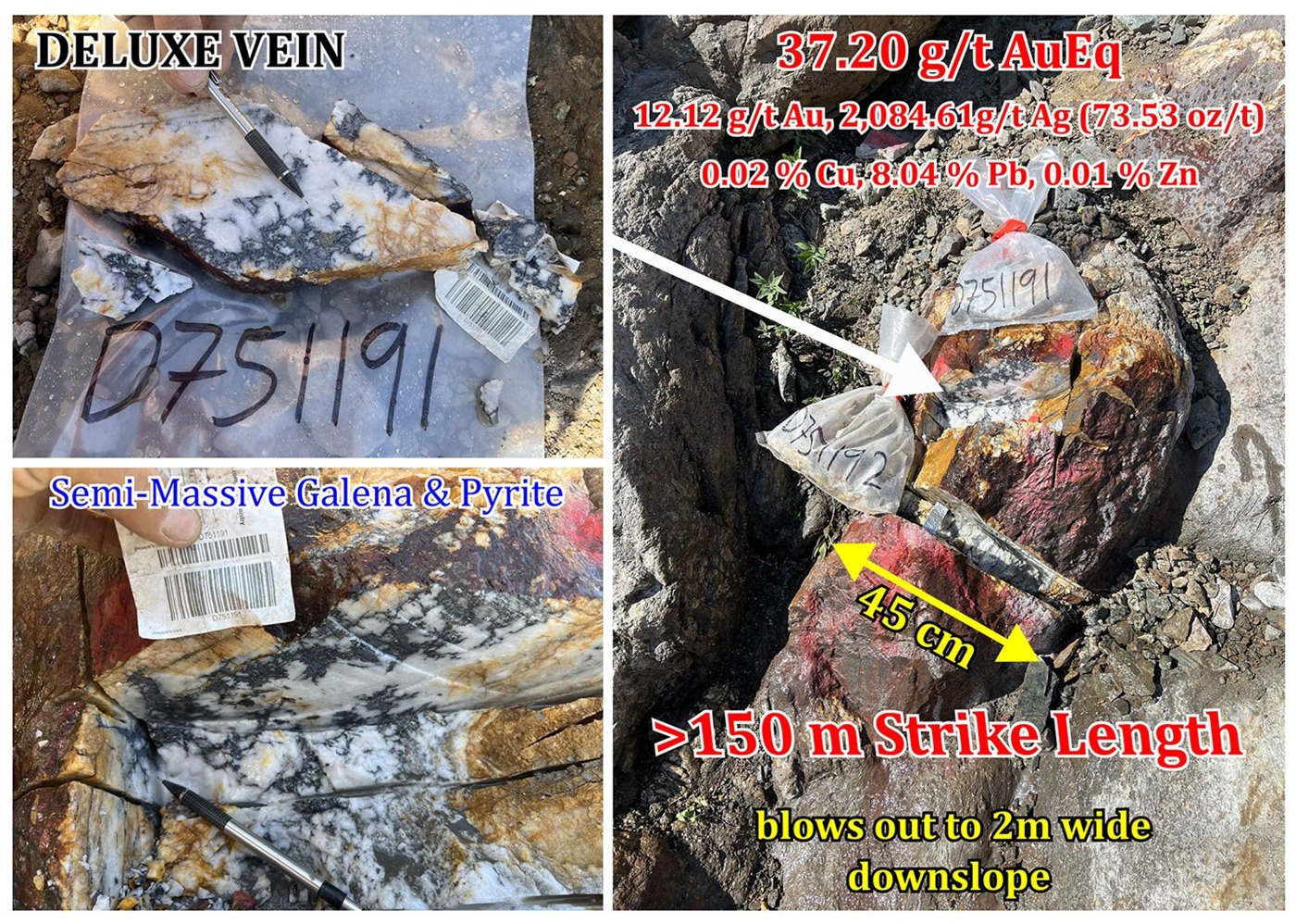
In addition to the drilling, the company restated selected surface sampling results. Grab samples from the Whopper Zone reached up to 44.76 g/t AuEq, while channel cuts returned up to 6.89 g/t AuEq over 4.00 m. Regionally, grab samples from Eldorado and Gold Swarm returned up to 263.70 g/t AuEq and 231.81 g/t AuEq. Juggernaut has expanded its 2026 exploration program from 10,000 m to approximately 13,000 m, with two rigs expected to operate through mid-to-late September, weather permitting.
Juggernaut Exploration Ltd. (JUGR) released visual observations from its Whopper Zone drill core, confirming the zone’s footprint in the rock. The company noted that these findings do not alter the resource, grade, recovery, or economic potential of the Big One deposit. The release follows extensive surface sampling and represents initial observations typical of a maiden drill program.
The stock price has already reacted to the broader Big One drill story, rising from approximately C$1.05 in late June 2026 to C$1.45 by August 25, 2026. This movement largely reflected anticipation of the Big Mac visual intercepts and the expanded drill program. The new visual data adds a second zone but provides no grade information.
Juggernaut Exploration Ltd. holds a market capitalization of approximately C$71M and had C$25.4M in cash as of June 30, 2026. The company stated that the equity already prices in substantial discovery optionality, and that a second visual footprint does not constitute material news until assay results are available.
Juggernaut Exploration Ltd. (JUGR) is a pre-revenue junior explorer focused on the Golden Triangle of British Columbia. Its primary asset is the 100%-controlled Big One property, which hosts the Eldorado System and Gold Swarm zones, characterized by polymetallic gold-silver-copper-lead-zinc veins and shears with inferred porphyry potential.
Other assets include the Midas property, an Eskay Creek-style VMS target; the Bingo property, a shear-hosted target; and additional smaller early-stage properties.
Financial position as of June 30, 2026:
- Cash: C$25.44M
- Working capital: C$19.46M
- No debt
- Shares outstanding around 50.0-50.9M
- Fully diluted around 63.9M shares including options and warrants
- Key shareholder: Crescat Capital at roughly 19.31%
This is an exploration-stage company with no resources, reserves, or production.