Tudor Gold Announces Positive Preliminary Economic Assessment for Treaty Creek's Goldstorm Deposit: Study Outlines Gold-Copper Underground Mine with Projected 28-Year Mine Life Producing 4,677,902 Ounces of Gold plus Copper and Silver
Tudor’s preliminary economic assessment projects a 20% internal rate of return at spot gold prices, yielding 166 koz per year against a 300 koz target.
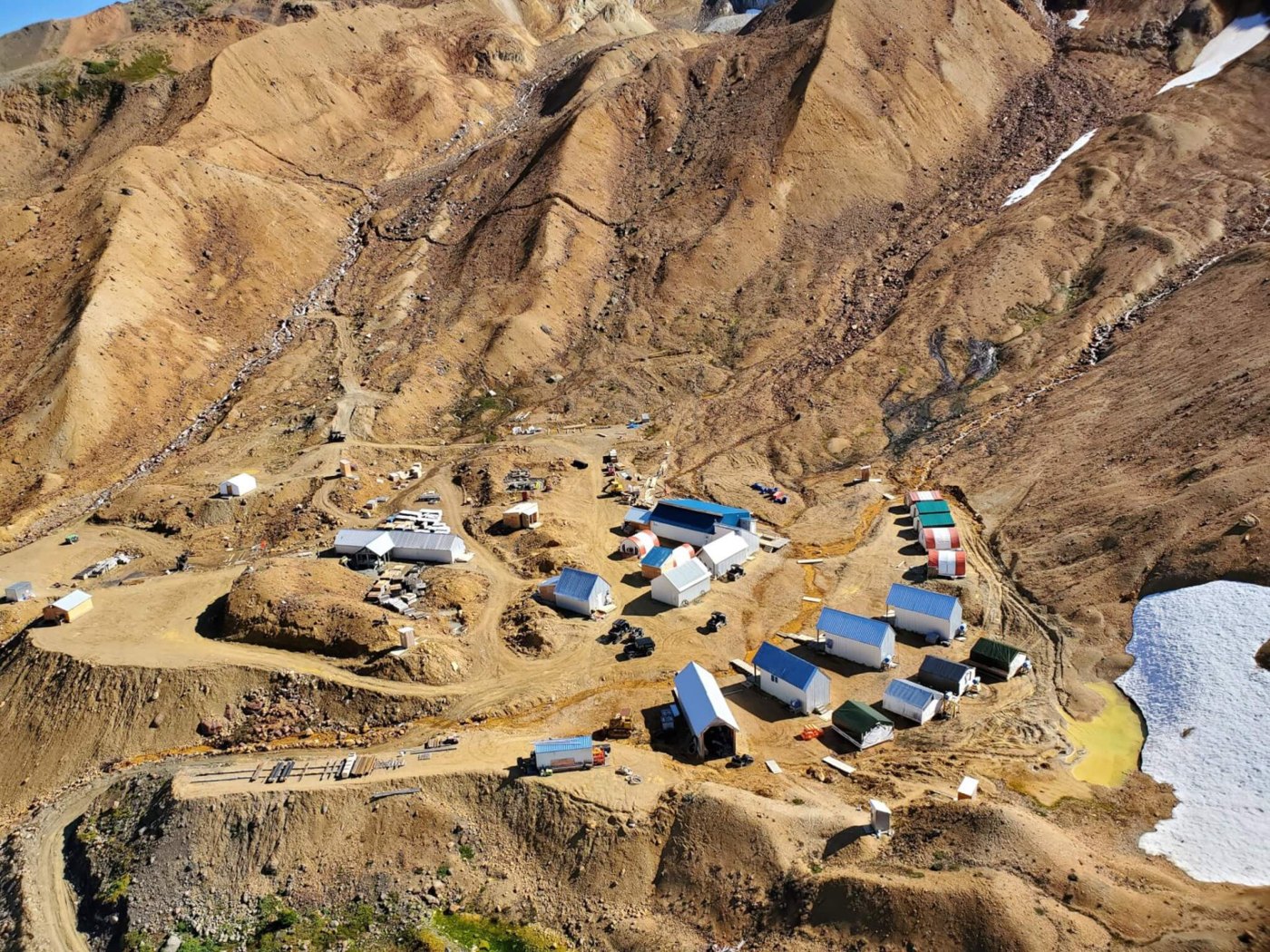
Tudor Gold Corp. (TUD) released a maiden Preliminary Economic Assessment (the "2026 PEA") for an underground mine at the Goldstorm Deposit within its 80%-owned Treaty Creek Project in British Columbia. Prepared by Fuse Advisors, part of SLR, with Mineral Resource input from Garth Kirkham of KGL, the study utilizes the January 22, 2026 Mineral Resource Estimate effective November 30, 2025. This marks the first economic study ever published on the project.
The 2026 PEA outlines a 28.25-year mine life with a nominal throughput of 10,000 t/d (3.8 Mtpa plant), employing long-hole open stoping with paste backfill and twin declines from surface. Life-of-mine (LOM) production is estimated at 4,677,902 oz of gold, 22,142,780 oz of silver, and 209,862 t of copper. Under a Base Case scenario assuming gold at US$3,670/oz, silver at US$50/oz, and copper at US$5.00/lb, the project yields an after-tax NPV5% of US$2.3B, an internal rate of return (IRR) of 20.0%, LOM after-tax cash flow of US$5.7B, and LOM revenue of US$17.8B. An Upside Case, with gold at US$4,500/oz, silver at US$70/oz, and copper at US$6.50/lb, projects an NPV5% of US$3.7B, an IRR of 26.8%, after-tax cash flow of US$8.6B, and revenue of US$22.4B.
Pre-production capital is estimated at US$1.541B, including contingencies, broken down into mining at US$206.4M, construction at US$769.2M, other costs at US$292.7M, and contingencies at US$272.5M (generally 30%, lower on some items). Additional capital requirements include sustaining development at US$438.7M, sustaining capital at US$355.9M, and reclamation at US$178.0M. LOM cash costs are estimated at US$1,143/oz, with all-in sustaining costs (AISC) by-product at US$1,358/oz in the Base Case and US$1,181/oz in the Upside Case. The payback period is 3.7 years for the Base Case and 2.9 years for the Upside Case.
Average annual production for years 3-12 is projected at 202,262 oz of gold, 755,843 oz of silver, and 7,295 t of copper, while LOM averages are 165,589 oz of gold, 783,815 oz of silver, and 7,429 t of copper. Recoveries are estimated at 82.7% for gold, 85.0% for silver, and 87.5% for copper, producing a bulk sulphide concentrate grading approximately 16.5 g/t gold and 2.4% copper. Operating costs are estimated at US$31.70/t mined for mining, US$12.77/t milled for processing, and US$20.73/t milled for general and administrative expenses. The exchange rate used is USD:CAD 1.425. A "Spot Case" column, using gold at US$3,668, silver at US$42.52, and copper at US$5.62 as of November 23, 2026, produces an identical NPV of US$2.3B and IRR of 20.0%, indicating the Base Case gold price is essentially spot.
The mining inventory comprises 97.82 Mt at 1.80 g/t gold, 2.10 g/t gold equivalent, and an NSR of US$174/t, containing 5,657 koz of gold in the plan. The recovered LOM gold of 4,678 koz reconciles with the stated 82.7% gold recovery. The plan includes four zones: SC1 (7.39 Mt @ 4.06 g/t gold, utilizing longitudinal retreat with the highest grade, requiring 16.5 km of capital lateral development, and exhausted by year 14); DS5 (22.01 Mt @ 2.15 g/t gold, utilizing transverse mining); CS600 (46.99 Mt @ 1.26 g/t gold, carrying most of the copper at 0.46% Cu, utilizing transverse mining with 113.9 km of lateral development over the full mine life); and 300HN (21.43 Mt @ 1.85 g/t gold, entering in year 8).
Total capitalized development is 76 km, including 68.5 km of capital lateral and 5.72 Mt of development material. The nameplate capacity of approximately 10,000 t/d is reached in year 4, with a peak total mining rate of 10,438 t/d in year 16. Stope optimization design assumptions use lower metal prices (gold at US$3,250/oz, silver at US$40/oz, copper at US$4.50/lb) than the Base Case economic prices. Dilution is estimated at 1.0 m of hanging wall and footwall ELOS in longitudinal stopes, and 2.0 m plus 8% zero-grade paste dilution in transverse stopes, with minimum diluted widths of 5.0 m and 14.0 m. The plant will process 41.9 Mt over years 1-12, starting with 2,753 kt in year 1, 2,616 kt in year 2, and approximately 3.5-3.8 Mt/a thereafter.
The
Tudor Gold Corp. (TUD) released a preliminary economic assessment (PEA) for its underground project on November 24, 2026, delivering results that fall short of earlier guidance and internal targets. The study outlines a 97.82 million tonne resource at 1.80 g/t Au (2.10 g/t AuEq), with a mine plan dominated by lower-grade material. Specifically, the plan includes 46.99 million tonnes of CS600 at 1.26 g/t Au, 22.01 million tonnes of DS5 at 2.15 g/t Au, and only 7.39 million tonnes of SC1 at 4.06 g/t Au. This contrasts with the February 25, 2026, PEA launch scope, which targeted 50-100 million tonnes of material grading greater than 2.5 g/t Au. The delivered gold grade is approximately 28% below the bottom of that stated target.
Production forecasts also missed earlier projections. On January 22, 2026, the company’s CEO stated a strategy targeting roughly 300,000 ounces of gold per year. The new PEA delivers an average of 202,262 ounces per year in years 3-12 and 165,589 ounces per year over the life of mine (LOM). No single year in the disclosed Years 1-12 table reaches 300,000 ounces, with the peak production occurring in Year 3 at 262,500 ounces. The long-run run-rate is roughly 45% below the figure used to frame the equity story ten months prior.
The project timeline has also slipped. The PEA was guided to a Q3 2026 completion in releases from February, May, and June, but arrived in November 2026, a slippage of roughly one quarter. Additionally, a December 2025 year-end review promised a "staged" development plan, starting with higher-grade lenses and scaling up based on metal prices and capital paydown. The delivered plan is a single-phase US$1.54 billion build to 10,000 tonnes per day (t/d) with nameplate capacity in year 4, lacking the staged capital profile previously described.
Despite the misses, the study provides the first-ever net present value (NPV) and internal rate of return (IRR) metrics for the asset. At a 5% discount rate, the post-tax NPV is US$2.3 billion, which is approximately C$3.28 billion at the release's own 1.425 foreign exchange rate—about 14 times the company's current market capitalization of C$231.5 million. On a per-share basis, the undiscounted headline value is about US$5.57. The study projects a NPV to initial capital expenditure ratio of 1.49x, a 3.7-year payback period, and an all-in sustaining cost (AISC) of US$1,358/oz against a base gold price of US$3,670/oz, representing a margin of approximately US$2,300/oz. The project is designed to support a 28-year, 10,000 ounces per day operation.
The economic model relies heavily on current gold prices. The Base Case gold price of US$3,670/oz is essentially the spot price of US$3,668/oz quoted in the same table. At this price, the study returns a 20.0% after-tax IRR for a 28-year, remote, unpermitted, reserve-less mine. The release provides only Base and Upside cases, with gold prices ranging between US$3,670 and US$4,500. There is no disclosed downside sensitivity table. A single US$1,000/oz fall in gold would compress the margin severely, given the US$1,358/oz AISC.
The capital requirements present a significant financing challenge. The US$1.541 billion in pre-production capital equals roughly 9.5 times the company's entire market capitalization and about 830 times its US$1.87 million cash position as of September 30, 2026. The company cannot fund this from treasury and would require a partner, a strategic or joint venture transaction, project debt plus stream, or equity issuance. The capital intensity is high at approximately US$154,000 per daily tonne of installed capacity, supported by 76 km of capitalized development.
The study does not de-risk two critical areas: reserves and geological confidence. There are still no reserves, and 29% of the gold ounces mined come from Inferred material. The release notes this twice, in both the risk section and the cautionary note. A PEA leaning on Inferred ounces for nearly a third of its gold has not converted the resource risk that a development-stage investor is underwriting.
Permitting and tenure issues further complicate the project. The company's release states that Seabridge's License of Occupation overlaps the planned process plant and underground development. The tailings facility location depends on an agreement, and there is no environmental assessment underway, no mine permit, and the underground exploration permit needed to start the decline is still outstanding. The study's schedule assumes pre-construction definition drilling and twin-decline development as "advanced exploration," a sequencing that requires permits the company does not hold.
The market reacted negatively to the news. The stock closed at C$0.56 on the release date, down 8% on the day, one cent above the 52-week low of C$0.54 set on November 20. The shares were down 64% from the January 23, 2026, high of C$1.57. The stock fell from C$0.71 on November 10 to C$0.54 by November 20 and did not recover.
Financing risk is now acute. The MD&A flags going concern issues, cites the US$1.87 million cash balance, and notes an explicit commitment to spend US$5.31 million on qualifying flow-through exploration by December 31, 2026. The PEA, which recommends underground definition drilling and
Tudor Gold Corp. (TSXV: TUD; FSE: H56; OTC: TDRRF) is a precious and base metals exploration and development company with no revenue and no production. The company’s flagship asset is the 17,913-hectare Treaty Creek Project in British Columbia’s Golden Triangle, in which Tudor holds an 80% interest. Teuton Resources holds the remaining 20%, and Tudor has been in discussions to acquire that stake since purchasing American Creek Resources in September 2025.
The Treaty Creek Project borders Seabridge Gold's KSM property to the southwest and Newmont's Brucejack Mine property to the southeast, occupying the same corridor that is the source of a tenure overlap dispute. The claims cover roughly 9 km of the Treaty Creek Thrust Fault system.
Goldstorm Deposit resources, based on a 2025 mineral resource estimate effective November 30, 2025, include: * Indicated: 912.3 Mt @ 0.85 g/t Au, 5.07 g/t Ag, 0.15% Cu = 24.9 moz Au, 148.7 moz Ag, 3.048 Blb Cu * Inferred: 21.8 Mt @ 3.64 g/t Au, 10.22 g/t Ag, 0.14% Cu = 2.6 moz Au, 7.2 moz Ag, 67.9 Mlb Cu
The Inferred resource reflects a US$125/t NSR sensitivity. In a January 2026 release, the base-case Inferred resource was reported as 86.1 Mt @ 1.43 g/t for 4.0 moz.
Other zones on the property include Perfectstorm, comprising the PSP porphyry and PSE epithermal deposits discovered and expanded in 2026 approximately 1 km west of Goldstorm; CBS, a gold-rich and newly identified silver-rich breccia; and Eureka. None of these zones are included in the preliminary economic assessment.
Tudor filed a permit application in August 2025 for an underground ramp to the high-grade SC-1 Zone. A 2026 preliminary economic assessment is now on the table, with a portal and decline targeted for 2027 subject to the underground exploration permit.
The company’s leadership team includes Joseph Ovsenek as President and CEO, Ken Konkin as SVP Exploration (P.Geo., QP), Ken McNaughton as VP Project Development (QP for the PEA), Grant Bond as CFO, Michelle Romero as VP External Affairs, and Chris Curran as VP IR. The presentation markets the team as having Brucejack discovery, development, and operating experience, a claim that is company-authored and not independently verified in the materials provided.